Overview
At a glance
Is this game right for my group?
ABG editorial scores on a 1–5 scale.
Harder to teach
High replayability
Highly interactive
Scales well
Deep strategy
How it plays
How does it play?
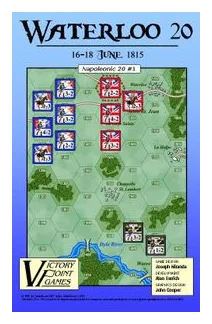
With Napoleon’s escape from exile and return to France, his Grande Armée is once again on the march. Can the Anglo-Allied forces under Wellington and the Prussian army under Blücher stop him?
Core mechanisms
Key systems that shape the decisions players make.
Read the full game description
With Napoleon’s escape from exile and return to France, his Grande Armée is once again on the march. Can the Anglo-Allied forces under Wellington and the Prussian army under Blücher stop him? Waterloo 20 is the first in a series of games featuring low unit density on the map (20 pieces or less per side) and medium complexity. Veteran designer Joseph Miranda has reduced the complexity and focused the scope of Napoleonic campaigns with his Napoleonic 20 game system. This system provides for operational level maneuvers and also has random event cards and night game turns to provide some of the “friction of war” that affected both sides greatly during the campaign. Morale plays an important role on both sides as players can ‘spend’ some to force march their pieces, help rally stragglers, or urge their troops on as they advance in battle. Consists of 9 pages of rules (8 for standard rules, one for game-specific rules), 40 die-cut 5/8" counters, an 11" x 17" map and 12 random event cards.