Overview
At a glance
Is this game right for my group?
ABG editorial scores on a 1–5 scale.
Harder to teach
High replayability
Highly interactive
Scales well
Deep strategy
How it plays
How does it play?
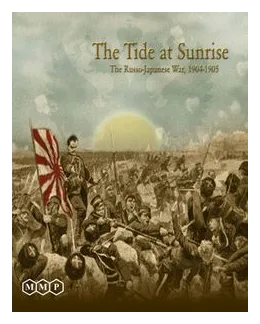
(from Multi-Man Publishing web site:) Tide at Sunrise continues the philosophy that began with A Victory Lost. Using tried and true mechanics but with some major twists, Tide at Sunrise will be a major test of player skill that is rarely seen in the wargaming hobby.
Core mechanisms
Key systems that shape the decisions players make.
Dice Rolling
Roll dice to introduce uncertainty into actions, production, movement, or resolution.
Simulation
Model a real or imagined system through detailed cause-and-effect rules.
Hexagon Grid
Use a hexagonal map where each space connects evenly in six directions.
Solo / Solitaire Game
Provide rules and objectives designed for a single player.
Read the full game description
(from Multi-Man Publishing web site:) Tide at Sunrise continues the philosophy that began with A Victory Lost. Using tried and true mechanics but with some major twists, Tide at Sunrise will be a major test of player skill that is rarely seen in the wargaming hobby. Here, the base system is little more than the tried and true game from SPI called Napoleon at Waterloo. But not all is at it seems. Here is the sequence of play: Japanese Player Turn * Naval Phase * Transport Allocation * Movement Phase * Combat Phase * Replacement and Recovery Russian Player Turn * Colonel Akashi Secret Operations Phase * Transport Allocation Phase * Movement Phase * Combat Phase * Supply and Recovery Phase After the completion of both Player Turns, victory points are determined and, if the Japanese have not won a sudden death win, play continues to the next turn. The game focuses on two aspects of the actual event. Players have to manage their armies using an abstract logistical system called “Transport Points” in the game. The Japanese Transport Points are an abstraction of the merchant marine force that the Japanese had available in 1904 and 1905. This can be disrupted from Russian naval activity. The Russian Transport Points are an abstraction of the rail capacity of the newly built Trans-Siberian Railroad. Weather can affect this total if there are heavy snows in Siberia. Colonel Akashi can also stir up trouble and reduce the available Russian Transport totals with sudden strikes and riots in the Russian heartland. Both players use these points to bring on new forces and to replace battlefield losses. Finding the right balance of the two uses is key to being successful in the game. Secondly, players must find the delicate balance between defending and attacking on two separate fronts. How much defends and attacks towards the all-important port of Port Arthur and how much attacks or holds the tough mountain passes of Manchuria - the key to the open plains to the north – where terrain is less defensible and victory points are everywhere. Victory in the game is determined by success in the naval war, the capture of key terrain objectives and enemy losses. Game components: * One 22” by 39” full color map * 140 1/2” land formation counters * 44 1 1/4” by 5/8” ship counters * 16 page full color rulebook Game summary: * Playtime: 3-5 hours * Complexity: Simple * Solitaire rating: excellent Game scale: * Turns: 12 (each turn represents one month of real time) * Counters: Divisions and Brigades for the land units, Capital Ships for the naval units * Hex scale: 10 kilometers Game Credits: * Designer: Yukihiro Kuroda * Developer: Adam Starkweather * Graphic Artist: Niko Eskubi