Overview
At a glance
Is this game right for my group?
ABG editorial scores on a 1–5 scale.
Harder to teach
High replayability
Highly interactive
Scales well
Deep strategy
How it plays
How does it play?
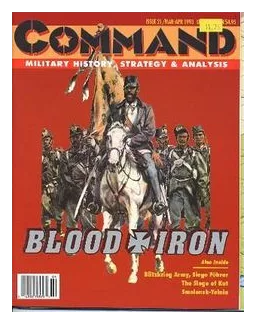
Blood & Iron: The Battle of Koniggratz, 1866, was the decisive battle of the Austro-Prussian War, in which the Kingdom of Prussia defeated the Austrian Empire.
Core mechanisms
Key systems that shape the decisions players make.
Read the full game description
Blood & Iron: The Battle of Koniggratz, 1866, was the decisive battle of the Austro-Prussian War, in which the Kingdom of Prussia defeated the Austrian Empire. Taking place near Königgrätz and Sadowa in Bohemia on 3 July 1866, it was an example of battlefield concentration, a convergence of multiple units at the same location to trap and/or destroy an enemy force between them. There are some extensive rules for cavalry charges, artillery, morale loss, and weather effects. The game also includes a number of 'what if?' scenarios which include alternate orders of battle as well as the historical one. Game length and victory conditions are determined by the scenario being played. Victory usually relies on capture of geographical objectives and/or elimination of opponent's forces. The game was first published as a supplement to Command Magazine Issue #21 Mar-Apr 1993. Not to be confused with 3W's Blood and Iron, this game is a two-player wargame covering the battle of Koniggratz (3 July 1866), the decisive battle of the 7 Weeks War between Austria and Prussia. Game Scale: Game Turn: 1 hours Hex: 500 yards / 457 meters Units: Brigade Game Inventory: One 22 x 34" full-color mapsheet One dual-side printed countersheet (240 1/2" counters - 200 for Blood & Iron, 6 for Tet '68 & 34 for Gettysburg) One 24-page Blood & Iron rulebook One 12-page Lost Victory Study Booklet (Designers Notes) Two 4-page dual-side printed Player Aid Cards One 10-sided die Solitaire Suitability: Medium Complexity Level: Medium Players: 2 or more Playing Time: 2-12 hours