Overview
At a glance
Is this game right for my group?
ABG editorial scores on a 1–5 scale.
Harder to teach
High replayability
Highly interactive
Scales well
Deep strategy
How it plays
How does it play?
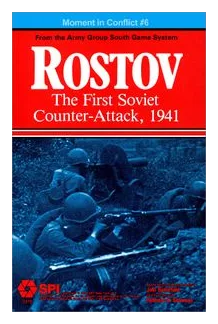
Rostov: The First Soviet Counter-Attack, 1941 is a division/regiment level simulation of the German drive across the Donets Basin in the fall of 1941.
Core mechanisms
Key systems that shape the decisions players make.
Movement Points
Spend a movement allowance across spaces with different costs.
Dice Rolling
Roll dice to introduce uncertainty into actions, production, movement, or resolution.
Hexagon Grid
Use a hexagonal map where each space connects evenly in six directions.
Combat Results Table
Compare opposing strength as a ratio, then consult a table to resolve combat.
Zone of Control
Restrict or influence movement through areas controlled by nearby pieces.
Read the full game description
Rostov: The First Soviet Counter-Attack, 1941 is a division/regiment level simulation of the German drive across the Donets Basin in the fall of 1941. Army Group South, accompanied by various Axis-Allied Armies, attempted to seize the valuable communications junction at Rostov and establish bridgeheads across the Donets and lower Don rivers. In the fighting around Rostov, the Germans suffered their first strategic setback in their campaign against Russia, as the Soviet Army drove the German mechanized spearhead from this vital area. The Axis Player controls all the German and Axis-allied (Rumanian, Hungarian, Italian and Slovakian) units; the Soviet Player controls all the Soviet units. This marks the sixth installment in SPI's Moment in Conflict Series for the Army Group South Game System. Rostov is an operational simulation, which recreates the pivotal battle of Rostov in 1941. A battle which saw the Germans actually take hold of Rostov, only to be driven out within weeks by wave after wave of Soviet attacks. Game Scale: Game Turn: 2 days Hex: 10.5 miles / 17 kilometers Units: Regiment to Corps Game Inventory: One 17 x 22" five-color mapsheets One dual-side printed countersheet (200 1/2" counters) One 8-page Army Group South rulebook One 4-page Rostov rulebook Two dual-side printed Army Group South Charts & Tables Solitaire Playability: High Complexity Level: Medium Players: 2 or more Playing Time: 3-6 hours