Overview
At a glance
Is this game right for my group?
ABG editorial scores on a 1–5 scale.
Harder to teach
High replayability
Highly interactive
Scales well
Deep strategy
How it plays
How does it play?
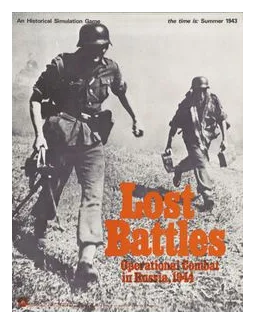
Strategy & Tactics magazine #28. Time Scale: 1 day per turn Map Scale: 2 km per hex Unit Scale: Battalion/Regiment Lost Battles is an operational game covering various Eastern Front battles at battalion - regiment level.
Core mechanisms
Key systems that shape the decisions players make.
Movement Points
Spend a movement allowance across spaces with different costs.
Dice Rolling
Roll dice to introduce uncertainty into actions, production, movement, or resolution.
Hexagon Grid
Use a hexagonal map where each space connects evenly in six directions.
Combat Results Table
Compare opposing strength as a ratio, then consult a table to resolve combat.
Zone of Control
Restrict or influence movement through areas controlled by nearby pieces.
Read the full game description
Strategy & Tactics magazine #28. Time Scale: 1 day per turn Map Scale: 2 km per hex Unit Scale: Battalion/Regiment Lost Battles is an operational game covering various Eastern Front battles at battalion - regiment level. These battles are fought on a generic map that represents the types of terrain found on the Eastern Front. The game has that essay quality of many Dunnigan designs. It intentionally does not try to be all encompassing but consciously focuses on specific strands of the story as simply and straight forwardly as possible. Good advice for storytellers and game designers. While a bit primitive by today's standards Lost Battles is nevertheless complete and playable presenting many interesting problems to be solved. Though only four scenarios are provided with game, the highly variable victory conditions actually make the game extremely replayable. The game also provides brief tools to design many scenarios of your own. In fact you could say that it is this that the game does most best. It is likely that many early designers played a game or two of this before going their own way taking with them the bits and pieces of the simulacrum that suited them.