Overview
At a glance
Is this game right for my group?
ABG editorial scores on a 1–5 scale.
Harder to teach
High replayability
Highly interactive
Scales well
Deep strategy
How it plays
How does it play?
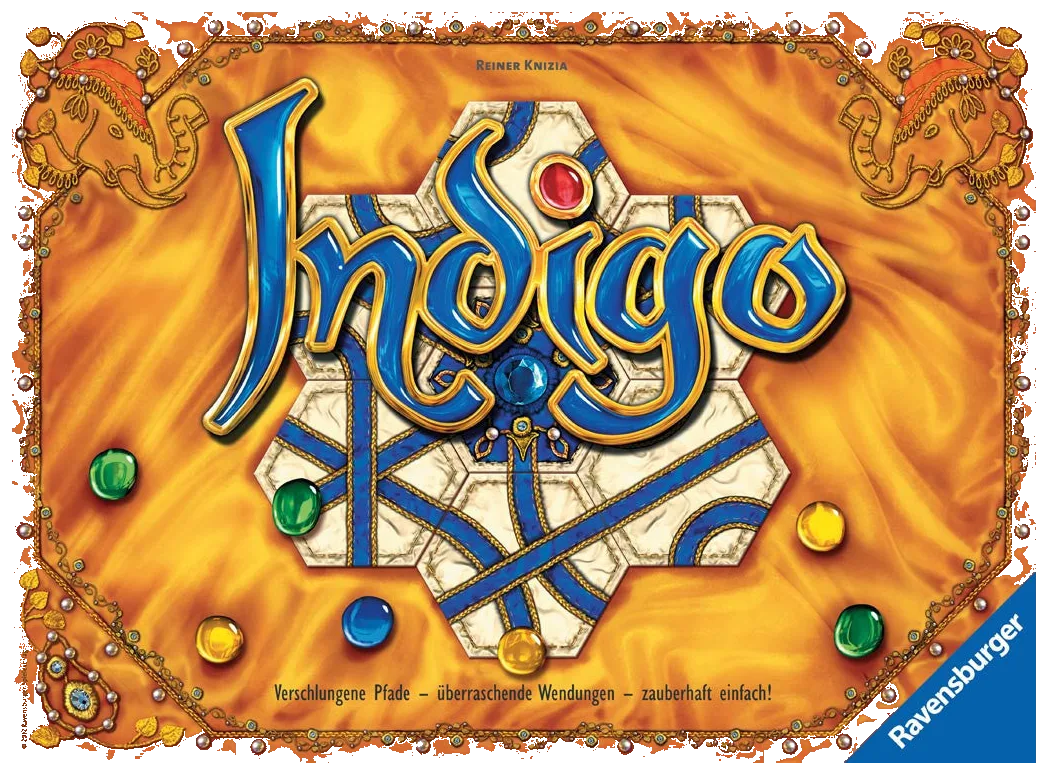
Indigo is a tile-laying game along the lines of Metro, Tsuro, and Linie 1 in which players build paths bit by bit, with no player owning the individual paths and everyone trying to exploit the paths already present.
Core mechanisms
Key systems that shape the decisions players make.
Network and Route Building
Create connected routes that improve reach, delivery, control, or scoring.
Tile Placement
Place tiles to build a shared or personal spatial arrangement.
Point-to-Point Movement
Move along explicit connections between named locations or nodes.
Hexagon Grid
Use a hexagonal map where each space connects evenly in six directions.
Read the full game description
Indigo is a tile-laying game along the lines of Metro, Tsuro, and Linie 1 in which players build paths bit by bit, with no player owning the individual paths and everyone trying to exploit the paths already present. Unlike those earlier games, however, your goal is to move gemstones from their starting locations on the board to your designated goals, with the player who scores the most points winning the game. To set up the game board, place the central hex tile, then add five green gems and one indigo gem to it. Place six "U-turn" tiles at their designated locations on the outer edge of the game board, then place a yellow gem on each such tile. Each player places goal markers on goals between these U-turn tiles on the edge of the game board: in a two-player game, the players alternate goals; in a three-player game, each player has one goal to herself, while sharing two others; and in a four-player game, each player shares a goal with every other player. On a turn, a player places a tile on any space on the game board, with the only restriction being that a player cannot create a route directly from one goal to another. Each tile has three route segments on it, connecting one pair of edges. If a player places a tile next to a gemstone, that gemstone "moves" as far as possible along the route so that all players can see where to place tiles to next move that gemstone. (Thus players avoid the mental gymnastics required in Metro and Linie 1 in which nothing moves until a route is complete.) When connecting to the central tile, the green gems move off first, with the indigo gem moving only with the sixth connection. If a player places a tile so that one gem would run into another, both gems are removed from the game! When a gem is moved to a goal owned by only one player, that player keeps the gem. If two players own the goal, then both players collect a gem of that color, taking the extra gem needed from the reserve. Once all the gems have been claimed, the game ends, with players earning 3 points for an indigo gem, 2 for green, and 1 for yellow. The player with the most points wins.