Overview
At a glance
Is this game right for my group?
ABG editorial scores on a 1–5 scale.
Harder to teach
High replayability
Highly interactive
Scales well
Deep strategy
How it plays
How does it play?
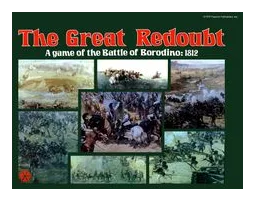
(from the rulebook:) The Great Redoubt is a [...] wargame that recreates [...] the Battle of Borodino, the most costly engagement of the Napoleonic Wars. Historically, the French attacked repeatedly, forced the Russians back, but failed to drive them from the field.
Core mechanisms
Key systems that shape the decisions players make.
Grid Movement
Move pieces between adjacent spaces on a regular grid.
Dice Rolling
Roll dice to introduce uncertainty into actions, production, movement, or resolution.
Movement Points
Spend a movement allowance across spaces with different costs.
Hexagon Grid
Use a hexagonal map where each space connects evenly in six directions.
Combat Results Table
Compare opposing strength as a ratio, then consult a table to resolve combat.
Simulation
Model a real or imagined system through detailed cause-and-effect rules.
Read the full game description
(from the rulebook:) The Great Redoubt is a [...] wargame that recreates [...] the Battle of Borodino, the most costly engagement of the Napoleonic Wars. Historically, the French attacked repeatedly, forced the Russians back, but failed to drive them from the field. After an unprecedented carnage, the French were marginally successful. Each hex on the mapboard is roughly 400 yards across. Each combat unit represents one actual regiment, brigade or division, cavalry brigade or division, or massed artillery formation. Each strength factor represents approximately 250 actual men or 3-8 guns. Each turn equals 30 minutes of actual time. 315 counters (4 of which are blanks)