Overview
At a glance
Is this game right for my group?
ABG editorial scores on a 1–5 scale.
Harder to teach
High replayability
Highly interactive
Scales well
Deep strategy
How it plays
How does it play?
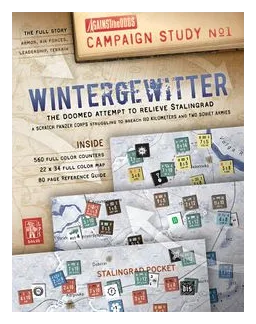
Wintergewitter: The Doomed Attempt to Relieve Stalingrad, is the first in the Campaign Study Series. It depicts the attack by the German 57th Panzerekorps to open a corridor to the 6th Army, trapped in the Stalingrad Kessel.
Core mechanisms
Key systems that shape the decisions players make.
Grid Movement
Move pieces between adjacent spaces on a regular grid.
Dice Rolling
Roll dice to introduce uncertainty into actions, production, movement, or resolution.
Movement Points
Spend a movement allowance across spaces with different costs.
Hexagon Grid
Use a hexagonal map where each space connects evenly in six directions.
Simulation
Model a real or imagined system through detailed cause-and-effect rules.
Read the full game description
Wintergewitter: The Doomed Attempt to Relieve Stalingrad, is the first in the Campaign Study Series. It depicts the attack by the German 57th Panzerekorps to open a corridor to the 6th Army, trapped in the Stalingrad Kessel. The fierce battle, that took place between December 12-23, 1942, was not a foregone conclusion. The fate of 20 German divisions hung in the balance—and the loss of 6th Army would turn the tide in the Eastern Front. The German player must use his initial advantage to open a corridor to 6th Army. The Soviet player will react quickly, but must first withstand a powerful enemy attack before he can bring powerful reinforcements to bear. The game scale is two miles per hex. Each turn represents 12 hours. Units vary in size from Companies to Army (headquarters only). Designer Mark Stille performed intensive research during the design. The German OOB is drawn from the actual War Diary of the 4th Panzerarmee and from the incomparable "Stalingrad" by Manfred Kehrig, a detailed German-language book on the subject. The USSR OOB is drawn from a superb 1943 Soviet General Staff study, and the Kehrig work. Soviet units vary from half-strength Rifle Divisions of 51st Army to the powerful formations of 2nd Guards Army. German units are depicted in a range of unit-sizes. This is a detailed OOB with plenty of counters—and myriad options—for both combatants. Game Scale: One hex: Two miles per hex One Game Turn: 12 hours of real time Units are: Companies, Battalions, Kampfgruppes, Regiments, Divisions, and aircraft units representing between 30 and 90 aircraft Game Components: One 22 x 34 inch color game map Two counter sheets (560 full color 1/2" counters) Campaign Study book with very extensive designer's and historical notes from the designer and a number of other notable contributors One 20 page rulebook Two Play Aid Cards One ten-sided die