Overview
At a glance
Is this game right for my group?
ABG editorial scores on a 1–5 scale.
Harder to teach
High replayability
Highly interactive
Scales well
Deep strategy
How it plays
How does it play?
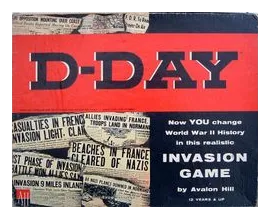
D-DAY portrays the Allied landings in France and the resulting drive to the Rhine.
Core mechanisms
Key systems that shape the decisions players make.
Grid Movement
Move pieces between adjacent spaces on a regular grid.
Dice Rolling
Roll dice to introduce uncertainty into actions, production, movement, or resolution.
Movement Points
Spend a movement allowance across spaces with different costs.
Hexagon Grid
Use a hexagonal map where each space connects evenly in six directions.
Combat Results Table
Compare opposing strength as a ratio, then consult a table to resolve combat.
Simulation
Model a real or imagined system through detailed cause-and-effect rules.
Read the full game description
D-DAY portrays the Allied landings in France and the resulting drive to the Rhine. Play takes the form of 50 game turns, each representing one week of real time, during which the Allies must establish a beachhead, breakout, organize a Patton-like dash across France, and sustain 10 divisions across the Rhine in the face of heavy German opposition. This was the first wargame to feature a hexagonal grid. There are 195 counters (15 rows of 13 counters per row) which includes some blanks. Re-implemented by: D-Day (3rd edition)