Overview
At a glance
Is this game right for my group?
ABG editorial scores on a 1–5 scale.
Harder to teach
High replayability
Highly interactive
Scales well
Deep strategy
How it plays
How does it play?
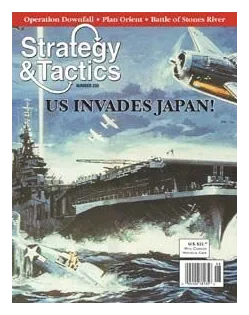
(from the publisher:) Downfall is a wargame simulating the planned but never executed US invasion of the Japanese home island of Kyushu during the last quarter of that year.
Core mechanisms
Key systems that shape the decisions players make.
Read the full game description
(from the publisher:) Downfall is a wargame simulating the planned but never executed US invasion of the Japanese home island of Kyushu during the last quarter of that year. The design combines factual historical detail with educated guesswork to produce an alternative history simulation covering the period from X-Day +1 through X-Day +30. One player acts as the overall commander of the Allied invasion effort; the other takes the role of the leader of the Japanese defense force. The burden of attack is generally on the American, but both players attempt to win by controlling key terrain on the island and destroying opposing forces. A complete game of DF takes from two to four hours to complete and it's suitable for solitaire play. The approach we've taken here is called, among those who deal regularly with alternative history – which is itself also known as "virtual history" and "alternative outcome analysis – the conservation of historical reality. That is, to make the assumptions and results of our simulation as valid as possible, we made the fewest possible changes needed to the historic timeline in order to put our alternative one in place. The basic assumption here, then, is that the Japanese simply refused to surrender after the atomic bombings of Hiroshima and Nagasaki. That would have likely meant one or another of the coups plotted during those desperate days actually went through, putting in place a new war cabinet of ultimate hard liners, men determined Japan should fight to the end no matter what. Each hex on the map equals 4.4 miles (about 7 kms) from side to opposite side. Each game turn represents one day. Every ground unit represents a division, division-equivalent, or brigade of about 5,000 to 20,000 men and/or 50 to 350 armored fighting vehicles. Designed by Ty Bomba. Published in Strategy & Tactics #230 (September-October 2005)