Overview
At a glance
Is this game right for my group?
ABG editorial scores on a 1–5 scale.
Harder to teach
High replayability
Highly interactive
Scales well
Deep strategy
How it plays
How does it play?
Linked game discovered from BGG. Full scrape pending.
Core mechanisms
Key systems that shape the decisions players make.
Area Majority
Compete to have the strongest presence in areas that award control or points.
Rondel
Move around a circular action track that limits which actions are currently reachable.
Advantage Token
A transferable advantage changes ties, priority, or the strength of an action.
Area Movement
Move pieces between connected regions rather than along individual spaces.
Tech Progression
Unlock or improve abilities by progressing through connected development paths.
Read the full game description
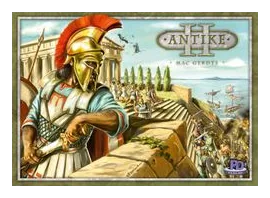
Antike II is a challenging strategy game about evolution and competition among ancient civilizations. Ancient nations create cities, build temples, sail the seas, and discover new principles of science and technology. Their legions and galleys open new settlements and defend their people against attacks from their enemies. Two scenarios can be chosen as the game board is two-sided. Every nation tries to win ancient kings, scholars, generals, citizens, and navigators for themselves. The nation that acquires a specified number (depending on the number of players) of ancient personalities first wins the game! Lead one of these nations to victory—but watch out for your enemies as they will want to conquer your cities to destroy your temples. The game depends not on the luck of dice or cards, but on thoughtful plans and skillful diplomacy. Antike II differs from the 2005 Antike in several ways, according to designer Mac Gerdts. To start, players now own city tokens, which allows them some degree of choice as to which resource a newly founded city shall produce. Military units have become more expensive, and the rules for the conquest of cities are considerably easier. The scientific progresses were altered as well. Neutral temples now exist, which may be destroyed, gaining VPs of a general, without harming other players. The game features two new maps in a new graphical design, and a new card named "BELLONA" (the ancient Roman goddess of war) has been introduced to counter the starting player's advantage. Gerdts notes that the main goal of all of these changes was to make the rules for a conquest of cities easier, while also opening more possibilities to win the game without the need to attack other players.