Overview
At a glance
Is this game right for my group?
ABG editorial scores on a 1–5 scale.
Harder to teach
High replayability
Highly interactive
Scales well
Deep strategy
How it plays
How does it play?
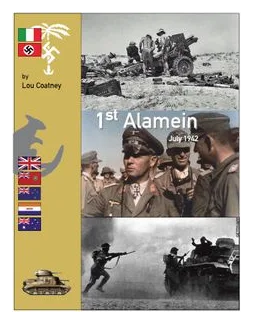
1st Alamein is my (Lou Coatney's) 1997-designed free, print-and-play 2-player game about the opening battle for Alamein, in July 1942, which was Rommel's best chance to break through and take naval base Alexandria, Cairo, and the Suez.
Core mechanisms
Key systems that shape the decisions players make.
Grid Movement
Move pieces between adjacent spaces on a regular grid.
Dice Rolling
Roll dice to introduce uncertainty into actions, production, movement, or resolution.
Movement Points
Spend a movement allowance across spaces with different costs.
Hexagon Grid
Use a hexagonal map where each space connects evenly in six directions.
Secret Unit Deployment
Place or assign units secretly before their positions are revealed.
Simulation
Model a real or imagined system through detailed cause-and-effect rules.
Read the full game description
1st Alamein is my (Lou Coatney's) 1997-designed free, print-and-play 2-player game about the opening battle for Alamein, in July 1942, which was Rommel's best chance to break through and take naval base Alexandria, Cairo, and the Suez. It is the first part of my Battles for Alamein game set, and it is an ideal introductory game for the hex-and-counter game format. It uses archaic (but surprisingly realistic) combat mechanics with "active Zones of Control" requiring combat - except of Allied units already in brigade boxes/fortifications - which can be taken and eliminated. The icons/figures on the pieces are by my older son Robert, who was also the playtester to the point of helping me design the game. (We have played it hundreds of times together, even in video telephone conversations.) Graphics guru Patrick Tremoureux has used those to produce professional quality map and units. The scale of the game is: 1 day of real time per (10) game-turn(s), approximately 6 miles/10 kilometers per hexagonal space width, and brigade-to-division (8,000-15,000 men) unit scale, which amounts to 12 ground units on each side. It takes a little over an hour to play.