Overview
At a glance
Is this game right for my group?
ABG editorial scores on a 1–5 scale.
Harder to teach
High replayability
Highly interactive
Scales well
Deep strategy
How it plays
How does it play?
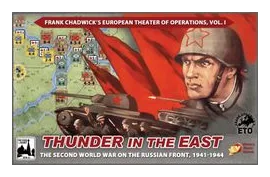
Description from the publisher: Frank Chadwick’s ETO (European Theater of Operations) is a series of linked games covering the land campaigns of World War II in Europe using a constant map and unit scale, and common rules.
Core mechanisms
Key systems that shape the decisions players make.
Grid Movement
Move pieces between adjacent spaces on a regular grid.
Dice Rolling
Roll dice to introduce uncertainty into actions, production, movement, or resolution.
Hexagon Grid
Use a hexagonal map where each space connects evenly in six directions.
Simulation
Model a real or imagined system through detailed cause-and-effect rules.
Read the full game description
Description from the publisher: Frank Chadwick’s ETO (European Theater of Operations) is a series of linked games covering the land campaigns of World War II in Europe using a constant map and unit scale, and common rules. Thunder in the East is the first game in that series, this one covering the titanic struggle on the Russian Front. This is a two-player game (although teams or even solitaire play would be just fine): one player assumes the role of the Axis (Germany and its allies) and the other player assumes the role of the Soviets (i.e., the Soviet Union). The individual ground units represent Divisions of 10-15,000 soldiers, Corps (from the Latin word "Corpus," meaning body) of approximately 25-50,000 soldiers, or Armies of approximately 75,000 or more men. The Soviet ground units are mostly armies of approximately 40,000 men each, with a few cavalry and airborne corps of about 10,000 men each. Air units represent about 200 combat aircraft early in the war, and gradually more as the war progresses. Each hex on the map represents 30 miles of actual terrain from side to side, and each Game Turn represents the passage of 7.5 days (or up to 15 days during inclement weather).