Overview
At a glance
Is this game right for my group?
ABG editorial scores on a 1–5 scale.
Harder to teach
High replayability
Highly interactive
Scales well
Deep strategy
How it plays
How does it play?
This “quiet northern flank” of Operation Barbarossa was anything but quiet. Army Group North, commanded by Field Marshal von Leeb, was given an important strategic goal – Target: Leningrad!
Core mechanisms
Key systems that shape the decisions players make.
Read the full game description
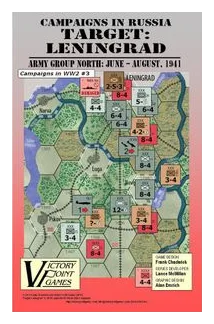
This “quiet northern flank” of Operation Barbarossa was anything but quiet. Army Group North, commanded by Field Marshal von Leeb, was given an important strategic goal – Target: Leningrad! To capture this second capital of Russia and the birthplace of Soviet communism would deal a severe psychological blow to the enemy, protect the northern flank of Army Group Center, and bring an overland route into Finland, Germany’s Axis ally in the north. Hitler would obsess on the capture of Leningrad. Taking Latvia, Lithuania and Estonia in their Baltic drive, as well as the north regions of Byelorussia, the Germans found themselves facing stubborn resistance from the Red Army and the Soviet Baltic Sea Fleet. Several Soviet counteroffensives were launched, but the Baltic States were soon overrun and operational objectives such as Talinin eventually fell to the German Blitzkrieg. The Soviets would improvise defensive barriers like the Luga Line, but Germans kept coming... Target: Leningrad is a new game from legendary game designer Frank Chadwick, iterating the Campaigns in Russia game system used in Battle for Moscow, The Arduous Beginning and Objective: Kiev (The Advance of Army Group South: June-August, 1941). Featuring countless opportunities and variations, Target: Leningrad presents an endlessly fascinating series of puzzles, filled with rich historical narrative in every move, as Leningrad becomes the focus of this great campaign. Complexity: 2.5 on a 9 scale Solitaire Suitability: 8 on a 9 scale Scale: Each unit is one German corps or Soviet army or corps, and each turn is approximately eight days. Game Components: • One 6-page, color Standard Rules booklet • 32 color, two-sided die-cut 5/8” mounted pieces • One 11” x 17” color game map with tables • 1 Player Aid sheet