Overview
At a glance
Is this game right for my group?
ABG editorial scores on a 1–5 scale.
Harder to teach
High replayability
Highly interactive
Scales well
Deep strategy
How it plays
How does it play?
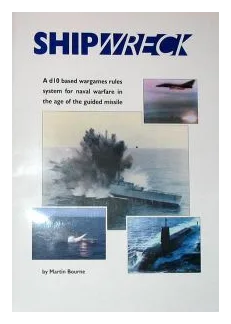
Vandering Publishing's Shipwreck is a very basic game of modern naval warfare. It already has one supplement released - "Freeplay '88", dealing with a NATO exercise in 1988.
Core mechanisms
Key systems that shape the decisions players make.
Paper-and-Pencil
Record choices and results directly on a personal sheet.
Dice Rolling
Roll dice to introduce uncertainty into actions, production, movement, or resolution.
Simultaneous Action Selection
Choose actions secretly or concurrently before revealing them together.
Measurement Movement
Measure physical distance to determine how far pieces may move.
Scenario Campaign
Play linked or standalone scenarios with their own setup, objectives, and consequences.
Simulation
Model a real or imagined system through detailed cause-and-effect rules.
Read the full game description
Vandering Publishing's Shipwreck is a very basic game of modern naval warfare. It already has one supplement released - "Freeplay '88", dealing with a NATO exercise in 1988. The game has been compared to "Harpoon 4", perhaps unfairly, as while it covers the same topic (modern naval warfare), the aim is present a much more global scope. Command of small fleets of ships is very easy in this game, as weapon effectiveness is determined by a single value and weapon damage is a single value (heavy, medium, light, etc). Ship damage are represented by a damage area with 4 damage levels - two 'lights', a 'heavy', and a 'critical' damage level. When a weapon damages a ship, a d10 is rolled and the weapon's size is compared against the size of the target ship on a chart to see the resulting damage level (with a chance of 'none' being one of the levels). If the given damage level is already called for, the next level up is used. The net effect is as mirrored by hypothetical naval combat - ships take very few hits to be 'mission killed'. Detection is handled within the rules in a very basic way, although special note should be made of the submarine rules. They make use of 'range bands' around a target ship. Submarines are not placed on the 'board' unless detected, making their approach and attack on these 'range band' diagrams, essentially their exact position unknown to BOTH players - neatly avoiding the need for a third player as referee almost always required in other games of the type. The production values of the game are fairly high - no counters or maps are included, but, given the nature of most modern naval games to use miniatures or simply graph paper, that's certainly forgivable. The game manual itself is printed on glossy paper with plenty of images throughout (several pages include color images) that really set the mood for the game.