Overview
At a glance
Is this game right for my group?
ABG editorial scores on a 1–5 scale.
Harder to teach
High replayability
Highly interactive
Scales well
Deep strategy
How it plays
How does it play?
Sheepshead is a trick-taking card game related to the Skat family of games. It is the Americanized version of a card game that originated in Central Europe in the late 18th century under the German name Schafkopf.
Core mechanisms
Key systems that shape the decisions players make.
Deduction
Combine clues and exclusions to identify hidden information.
Hidden Roles
Players conceal team, loyalty, or identity information from one another.
Hand Management
Time and sequence a limited hand of cards to preserve future options.
Trick-taking
Play one card each and award the trick according to suit and rank rules.
Team-Based Game
Players compete in fixed teams and coordinate toward a shared team result.
Read the full game description
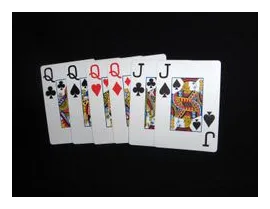
Sheepshead is a trick-taking card game related to the Skat family of games. It is the Americanized version of a card game that originated in Central Europe in the late 18th century under the German name Schafkopf. Sheepshead is played with 7-8-9-10-J-Q-K-A in four suits, for a total of 32 cards. A sheepshead deck is made by removing all of the jokers, sixes, fives, fours, threes, and twos from a standard deck. Card strength: Card strength in sheepshead is different than in most other games. It is one of the most difficult things for some beginners to grasp. There are 14 cards in the trump suit: all four queens, all four jacks, and all of the diamonds. In order of strength from greatest to least: Q? Q? Q? Q? J? J? J? J? A? 10? K? 9? 8? 7? Also, there are 6 of each "fail" suit (18 total). A, 10, K, 9, 8, and 7 of ?, ?, and ? Clubs, spades, and hearts take no precedence over other fail suits, unlike trump, which always take fail. (Notice how both aces and tens outrank kings; arguably the most confusing aspect of card strength). The lead suit must be followed if possible; if not, then any card may be played such as trump (which will take the trick), or a fail card. Playing a fail of a different suit is called "throwing off" and can be a way to clear up another suit. Additionally, throwing off a point card is called "schmearing". Card point values: Each card is given a separate point value as follows: Ace — 11 points Ten — 10 points King — 4 points Queen — 3 points Jack — 2 points 9, 8, 7 — 0 points The strongest cards (queens and jacks) are not worth the most points, giving Sheepshead some of its unusual character. There are 120 points total in the deck. The goal of the game is to get half of these (60 or 61); in case of a tie, the player who picked up the blind loses, and that player's opponents win. (There are variant rules for more peculiar situations, such as the Leaster.) This is one of the few traditional card games with a hidden partner. Jack of Diamonds is a random partner method where the picker receives a partner without needing to call or lead a suit. The picker can still choose to "go it alone", but needs to declare before the hand begins.