Overview
At a glance
Is this game right for my group?
ABG editorial scores on a 1–5 scale.
Harder to teach
High replayability
Highly interactive
Scales well
Deep strategy
How it plays
How does it play?
Linked game discovered from BGG. Full scrape pending.
Core mechanisms
Key systems that shape the decisions players make.
Area Majority
Compete to have the strongest presence in areas that award control or points.
Hand Management
Time and sequence a limited hand of cards to preserve future options.
Set Collection
Gather related items that become more valuable when scored together.
Tile Placement
Place tiles to build a shared or personal spatial arrangement.
Hexagon Grid
Use a hexagonal map where each space connects evenly in six directions.
Once-Per-Game Abilities
Each powerful ability may be used only once during the entire game.
Read the full game description
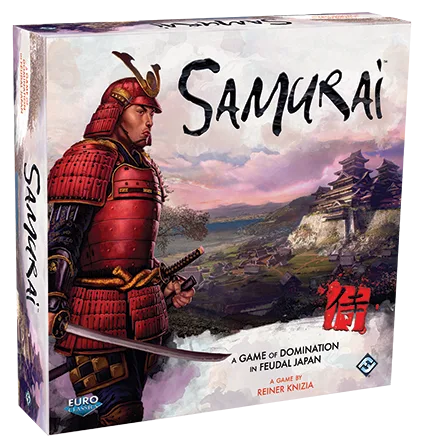
Samurai is set in medieval Japan. Players compete to gain the favor of three factions: samurai, peasants, and priests, which are represented by helmet, rice paddy, and Buddha figures scattered about the board, which features the islands of Japan. The competition is waged through the use of hexagonal tiles, each of which help curry favor of one of the three factions — or all three at once! Players can make lightning-quick strikes with horseback ronin and ships or approach their conquests more methodically. As each figure (helmets, rice paddies, and Buddhas) is surrounded, it is awarded to the player who has gained the most favor with the corresponding group. Gameplay continues until all the symbols of one type have been removed from the board or four figures have been removed from play due to a tie for influence. At the end of the game, players compare captured symbols of each type, competing for majorities in each of the three types. Ties are not uncommon and are broken based on the number of other, "non-majority" symbols each player has collected. The game is part of what is sometimes called the Knizia tile-laying trilogy.