Overview
At a glance
Is this game right for my group?
ABG editorial scores on a 1–5 scale.
Harder to teach
High replayability
Highly interactive
Scales well
Deep strategy
How it plays
How does it play?
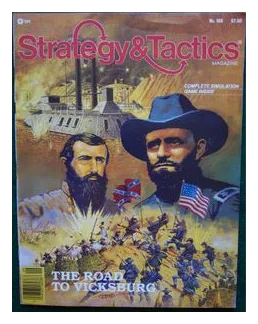
The Battle of Champion Hill game uses the Blue & Gray system. It was included in the Strategy & Tactics magazine Issue #103.
Core mechanisms
Key systems that shape the decisions players make.
Dice Rolling
Roll dice to introduce uncertainty into actions, production, movement, or resolution.
Combat Results Table
Compare opposing strength as a ratio, then consult a table to resolve combat.
Hexagon Grid
Use a hexagonal map where each space connects evenly in six directions.
Zone of Control
Restrict or influence movement through areas controlled by nearby pieces.
Read the full game description
The Battle of Champion Hill game uses the Blue & Gray system. It was included in the Strategy & Tactics magazine Issue #103. The May 16, 1863 Battle of Champion Hill was the largest, bloodiest, and most significant action of Grant’s Vicksburg Campaign. 32,000 advancing Union soldiers met 23,000 Confederates in a fierce struggle for a vital crossroads roughly halfway between Vicksburg and Jackson, Mississippi. The field was dominated by bald Champion Hill, from which Confederate artillery opened fire on the Union army at 9:45 A.M. The first Federal assault on the hill drove the Southerners back with bayonets and clubbed muskets. As the Union soldiers tried to reform and consolidate their gains, they were swept away by a counterattack led by John Bowen’s Missourians and Arkansans. Ulysses S. Grant ordered more men towards the hill and Bowen’s Confederates were themselves driven off, compelling a general retreat. Southern Brig. Gen. Lloyd Tilghman was killed while directing a desperate rearguard action that enabled most of the Confederate army to escape towards Vicksburg. The decisive Union victory at Champion Hill was instrumental in forcing the Confederates out of the open field and into a doomed position inside the walls of Vicksburg. Brief summary of rules: Stacking: • Up to 2 units may stack, unless optional stacking rule is used, which allows 5 units in one hex, as long as only one is of brigade level or higher. • Units in a stack must attack the same target. If desired, one unit of the stack may be withheld from attacks. Zone Of Combat/Enemy Zone Of Combat: • ZOC extends into all 6 adjacent hexes. ZOCs do not extend across river/creek hexsides, except at a ford or bridge. ZOC does extend across streams. • Units entering EZOC must stop moving. • No unit may voluntarily leave an EZOC except by combat results Combat Restrictions: • Units may only attack or be attacked once per phase. • Units may not split up their strength points to attack into separate adjacent hexes. • Units may attack all adjacent units of a group if desired. • Before rolling the die, the attacker may choose to reduce the combat odds (e.g., use the 2:1 table when attacking at 3:1). • Cavalry units attacked only by infantry may retreat 2 hexes before combat is resolved (opt.). The attacking units may enter the cavalry unit’s vacated hex, but they may not select an alternate target. Attacker Effectiveness (“Ar” results): • Attackers forced to retreat are flipped to their ineffective side. Attackers remain ineffective until a night turn. (Retreating defenders remain effective.) • Ineffective units may not attack, i.e., they may not enter EZOC. Ineffective units that begin their side’s combat phase in an EZOC must retreat. Retreats/Advances: • Units may not retreat off the map or through EZOC. • One unit of a stack may retreat one hex to make room for another unit retreating into its hex (displacement) • Any unit that cannot retreat is eliminated. • A unit that participates in an attack/defense resulting in a hex being cleared of enemy units (i.e., the enemy retreated or was eliminated) may advance into that hex. • Artillery may not advance after combat. Artillery Range Fire: • Artillery may attack units within 3 hexes. It may only do so if there is no adjacent enemy target. • Artillery ranged attacks must be made at odds ? 1:3. • Artillery units may never suffer adverse combat results when engaging in ranged fire. Night: • No combat phase. • Units adjacent to enemies may not move. • Units may move, but may not enter EZOC.