Overview
At a glance
Is this game right for my group?
ABG editorial scores on a 1–5 scale.
Harder to teach
High replayability
Highly interactive
Scales well
Deep strategy
How it plays
How does it play?
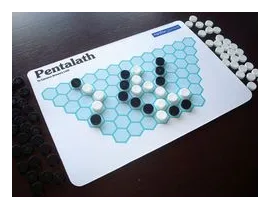
Pentalath (also called Ndengrod) is an abstract board game for two players, designed by a computer program called LUDI, invented by Cameron Browne. It is the "brother" of Yavalath and it can be played using a Yavalath set.
Core mechanisms
Key systems that shape the decisions players make.
Read the full game description
Pentalath (also called Ndengrod) is an abstract board game for two players, designed by a computer program called LUDI, invented by Cameron Browne. It is the "brother" of Yavalath and it can be played using a Yavalath set. It is available from nestorgames. Rules Players: White and Black. Start: The board is initially empty. Play: Players take turns placing a piece of their colour at an empty cell. After each move, any same-coloured groups with no freedom (i.e. no adjacent empty board cell) are captured and removed. End: Players win by making a line of five or more pieces of their colour. First move equaliser: The second player has the option of swapping colours in lieu of making the second move. This stops the first player from making too strong (i.e. central) an opening move.