Overview
At a glance
Is this game right for my group?
ABG editorial scores on a 1–5 scale.
Harder to teach
High replayability
Highly interactive
Scales well
Deep strategy
How it plays
How does it play?
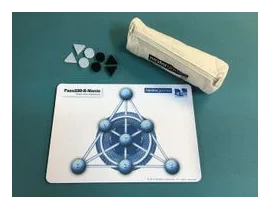
Fano330-R-Morris is a ruthless game, in that you can never win on your turn, but you can lose. The “Fano” portion of the name comes from the board, which depicts the Fano plane.
Core mechanisms
Key systems that shape the decisions players make.
Read the full game description
Fano330-R-Morris is a ruthless game, in that you can never win on your turn, but you can lose. The “Fano” portion of the name comes from the board, which depicts the Fano plane. The Fano plane is a finite projective plane with the minimum number of points and lines possible: 7 points and 7 lines (counting the circle), with 3 points on each line, and 3 lines through every point. The “330” portion of the name comes from the original playing pieces for the game: ¥330 of Japanese coins: Player 1 would use two ¥100 coins and two ¥50 coins, while Player 2 would use two ¥10 coins and two ¥5 coins. For the nestorgames edition, each player has pieces of one color: two circles and two triangles, in celebration of the geometry depicted in the Fano plane. How To Play The board starts empty. White plays first. Placement Phase Players take turns stacking one of their pieces on the circled spaces of the board, following The Stacking Rules below: A) Stack it on an empty space or… B) Stack it on another piece already on the board, applying The Stacking Rules as follow: a. No more than 2 pieces can be stacked on the same space. A stack consists of one or two pieces. b. Two pieces of identical shape and colour cannot be stacked. Movement Phase When the Placement Phase finishes, players take turns moving one of their pieces on the board, following the rules below: A) Move it to an adjacent space along a “line” (See the section "LINES"), following The Stacking Rules. B) When two pieces are stacked, only the upper piece can be moved. On your turn, you must move one of your topmost pieces from a stack along a line to an adjacent space, respecting the Stacking Rule. LINES The “lines” are defined as the 7 lines that connect thefollowing 3-space sets on the board: {1,2,4}, {5,2,3}, {3,4,6}, {6,1,5}, {2,7,6}, {4,7,5}, {1,7,3} Game End You lose if either of the following is true: a) 3 pieces of the same colour or same shape are in a “line” (remember, the circle is a “line”) when finishing your turn. Only consider the topmost piece in each space. (Placement or Movement Phase) b) You have no legal moves when starting your turn. (Movement Phase) Notice that the game might end during the Placement Phase. In case of repeated board positions, the game ends in a draw. Play again swapping colours.