Overview
At a glance
Is this game right for my group?
ABG editorial scores on a 1–5 scale.
Harder to teach
High replayability
Highly interactive
Scales well
Deep strategy
How it plays
How does it play?
Line or Colour is a combinatorial game for two players. Originally named Tangion (a contraction for Tangent+Tension), the game involves two perpendicular winning conditions that can tie players´ brains in knots.
Core mechanisms
Key systems that shape the decisions players make.
Read the full game description
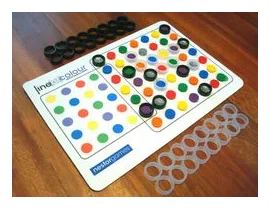
Line or Colour is a combinatorial game for two players. Originally named Tangion (a contraction for Tangent+Tension), the game involves two perpendicular winning conditions that can tie players´ brains in knots. It was derived from Domina 4 by adding a n-in-a-row victory condition and removing piece movement. The name was later changed to the more friendly Line or Colour. MATERIAL 49 rounded counters in 7 colours (7 each) 25 white rings 25 black rings The official edition includes a board for faster setup. RULES There are 2 types of gameplay: basic and advanced. Basic version: Arrange 25 counters in 5 colours (5 each) in a square according to the figure: 12345 45123 23451 51234 34512 Player 'White' (Starting player) takes all the white rings. Player 'Black' takes all the black rings. Starting with 'White' players alternate turns 'claiming' a counter by placing a ring of their colour on it. The pie rule is enabled. The game ends when a player either forms a row of at least 4 consecutive rings of his colour (orthogonal or diagonal) or has claimed 4 counters of the same colour. That player wins the game. Advanced version: Arrange 49 counters in 7 colours (7 each) according to the figure: 1234567 6712345 4567123 2345671 7123456 5671234 3456712 Same rules apply, but a player wins by making a line of 5 or claiming 5 counters of the same colour. The pie rule doesn't seem to be necessary in this version. Variant for both versions: Arrange the counters randomly. AKNOWLEDGEMENTS Special thanks to Stephen Tavener for playtesting and Cameron Browne for playtesting and game name brainstorming, that unlocked its publication almost a year after its inception.