Overview
At a glance
Is this game right for my group?
ABG editorial scores on a 1–5 scale.
Harder to teach
High replayability
Highly interactive
Scales well
Deep strategy
How it plays
How does it play?
An Inuit table top game that promotes healthy cohabitation with natural elements. A dynamic terrain management game in which nature and occupants seek to have greater influence with respect to others.
Core mechanisms
Key systems that shape the decisions players make.
Read the full game description
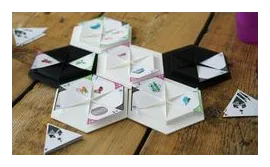
An Inuit table top game that promotes healthy cohabitation with natural elements. A dynamic terrain management game in which nature and occupants seek to have greater influence with respect to others. Like life, it starts simply, and then becomes challenging as you develop skills. Setup: Place the hexagonal bases in any layout. This is entirely up to the players, and can drastically change the game play, offering a lot of replay options. Place a number of cards face down randomly, again adding to replay. Deal each player 5 cards and choose your side (green or purple). Play: Players alternate turns placing the triangular cards into the slots on the hexagonal bases. Based on how you place a card, you may flip face down cards. The goal is to score points while maintaining balance between man and nature (purple and green). Points are earned when a base is full, but can be lost as more cards are played on that base. If your color has the most cards on a base, you gain 2 points for that area. If the total of the numbers on the cards in an area is positive, purple gets a point. If negative total, green gets a point. These points overlap with most cards of a color points, so keeping track of the points is important. The first player to 4 points wins. However, you are both playing with the same deck, and cards of each color, so it's not as simple as it may seem. You can raise or lower your opponent's total on an area, and if the total is +-7 or more, the corresponding color cards are all removed and play continues with what remains.