Overview
At a glance
Is this game right for my group?
ABG editorial scores on a 1–5 scale.
Harder to teach
High replayability
Highly interactive
Scales well
Deep strategy
How it plays
How does it play?
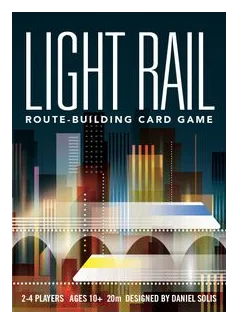
Overview: Citizens of a high-tech metropolis demand the most modern commuter train system in the world! The mayor hires several companies to build the network as a joint project, including yours!
Core mechanisms
Key systems that shape the decisions players make.
Area Majority
Compete to have the strongest presence in areas that award control or points.
Modular Board
Build the play area from interchangeable sections that vary between games.
Pattern Building
Place elements to create arrangements that satisfy scoring or action patterns.
Tile Placement
Place tiles to build a shared or personal spatial arrangement.
Read the full game description
Overview: Citizens of a high-tech metropolis demand the most modern commuter train system in the world! The mayor hires several companies to build the network as a joint project, including yours! Naturally, you’re trying to take the most credit for the network’s success. Complete routes with a variety of buildings to earn credit! Achieve your secret objectives to win extra credit at the end of the game. The player with the most credit wins! How to Play: Each player has their own personal color-coded deck of Rail Cards. Each Rail Card features two lines and two terminals in various combinations, thus all presenting six different outlets with varying connections or dead ends amongst them. Each card also features two different buildings, each situated on either of the two lines. (There are five different types of buildings.) Players take turns laying down one card at a time, adjacent to existing cards, to build the map of the city. Cards must be placed in a "brick" pattern. If placed so that the short sides are adjacent to one another, the cards must be in a straight line. However, if placed so that the long sides are adjacent to one another, the cards must be off-set. In this manner, a single card may have up to six adjacent cards. There is another limit to placement: Cards may not be placed outside of the city limits. This is a final shape of the city determined by the number of players. Though you know what shape the city will take at the end of the game, there is no "board" which predefines the "center" of the city. The city grows and shifts with each new card played. Controlling the growth and logic of the city is fundamental to strategic play. Scoring and Victory: Score "credit" by having the most segments of your color comprising a complete route. A route is complete when it is capped at both ends by a terminal or when it is made into a loop. Score 1 credit for each different type of building on a complete route. Extra credits may be scored by completing secret objectives, most of which require the city to meet certain configurations.