Overview
At a glance
Is this game right for my group?
ABG editorial scores on a 1–5 scale.
Harder to teach
High replayability
Highly interactive
Scales well
Deep strategy
How it plays
How does it play?
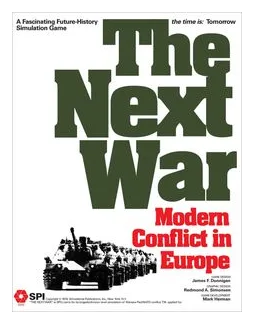
The Next War is a brigade/divisional level simulation of a Soviet-led Warsaw Pact invasion of the central European front of NATO in the late 1970's. The three maps cover the area from the far north of Denmark, through Germany and Austria to the industrial heartland of Italy.
Core mechanisms
Key systems that shape the decisions players make.
Read the full game description
The Next War is a brigade/divisional level simulation of a Soviet-led Warsaw Pact invasion of the central European front of NATO in the late 1970's. The three maps cover the area from the far north of Denmark, through Germany and Austria to the industrial heartland of Italy. The standard rules constitute the fast game, and contain all the rules necessary to play "The Next War" land game - a complete game that can be played independently. The most notable mechanic is the combination of combat within the movement of land units, with the ability of units to greatly exceed the basic movement allowance at increased risk of fatigue/attrition. Optional rules cover weather, supply, chemical/nuclear warfare, air and naval operations, airborne/airmobile and amphibious operations, helicopters and special forces, and electronic warfare and add can considerably to the record keeping and playing time. The campaign game covers the first 60 days after mobilization in three basic scenarios, Sudden War, Spring Maneuvers, Tension. The differences between these three concern the timing of the outbreak of war and the resultant state of readiness of the respective forces. Due to the large number of optional rules, however, the players may in fact choose from a vast array of possible Campaign Game situations. Six smaller scenarios depict smaller areas of operations over briefer periods of time in the regions of Berlin, Vienna, The Baltic, Fulda, North German Plains, and the Main Front (Fulda + North German Plains). The game components: three 22" x 35" map sheets plus one 6" x 8" and one 10" x 12" map extensions, 2400 die-cut 1/2" counters, one 32 page rules book, one 40 page Scenarios and Situation Briefing book, two identical 4 page Charts & Tables folders, and one 17" x 22" Air Allocation Display.