Overview
At a glance
Is this game right for my group?
ABG editorial scores on a 1–5 scale.
Harder to teach
High replayability
Highly interactive
Scales well
Deep strategy
How it plays
How does it play?
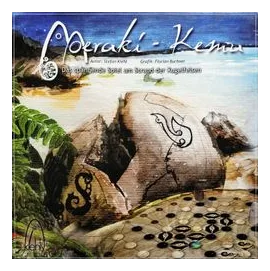
Moeraki - Kemu is about the rivalry between two Maori tribes on the southern island of New Zealand: the Matau (hooks) and the Manala (birds). The game is played on a diagonal grid, with the players playing pieces on the intersections.
Core mechanisms
Key systems that shape the decisions players make.
Read the full game description
Moeraki - Kemu is about the rivalry between two Maori tribes on the southern island of New Zealand: the Matau (hooks) and the Manala (birds). The game is played on a diagonal grid, with the players playing pieces on the intersections. The basic game is played as follows: At the start of the game, the first player places the neutral Moeraki-ball on one of the nine central intersections of the board. After that, the players take turns placing one of their own pieces on the board. When a square is on the board is completely enclosed by pieces, the player who has the majority (normally 3:1, but it can be 2:1 or 3:0 next to the edge or the neutral Moeraki-ball) claims the field and places a tribe marker on it. The game can be won in one of four ways: 1. Tahuna (beach): A player wins if he has enclosed a field with four of his own pieces. 2. Awa (river): A player wins if he has a piece on each of the intersections on one of the diagonal lines from one edge to another edge. 3. Ara (road): A player wins if he has a piece on each of the four intersections on one edge. 4. Marae (holy ground): When all the fields in the center have been claimed, players count the number of tribal markers they have got on the board (markers that are on the edge and that have been claimed with a 2:1 majority count only half). The player with the most markers wins the game. The players win several matches, until one of them has won the pre-determined amount of matches. In the advanced version of the game, both players receive a Maori-Tane (warrior). Once during the game, a player may place the Tane on the board instead of a tribal marker. When he does so, all he chooses a direction. Any fields between the Tane and the edge in that direction cannot be claimed; any markers already present are removed.