Overview
At a glance
Is this game right for my group?
ABG editorial scores on a 1–5 scale.
Harder to teach
High replayability
Highly interactive
Scales well
Deep strategy
How it plays
How does it play?
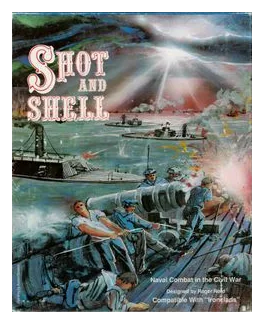
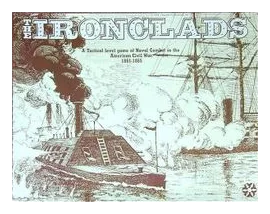
(from a Yaquinto ad:) The IRONCLADS is a tactical level, simultaneous movement, game of ship-to-ship combat in the American Civil War.
Core mechanisms
Key systems that shape the decisions players make.
Grid Movement
Move pieces between adjacent spaces on a regular grid.
Dice Rolling
Roll dice to introduce uncertainty into actions, production, movement, or resolution.
Hexagon Grid
Use a hexagonal map where each space connects evenly in six directions.
Line of Sight
Visibility between pieces determines valid targets, movement, or effects.
Movement Template
Use a physical template to determine legal movement paths or distances.
Simulation
Model a real or imagined system through detailed cause-and-effect rules.
Read the full game description
(from a Yaquinto ad:) The IRONCLADS is a tactical level, simultaneous movement, game of ship-to-ship combat in the American Civil War. Players move one or more of over 130 counters that represent individual ships over a large (42" x 27-1/2") four pieceqeomorphlc mapboard as they attempt to outmaneuver and out-shoot their opponents. 45 ship specification cards give such vital information as the number, size, location and play of individual guns that are fired separately using specific range and penetration tables for each weapon. The ship specification card also contains target information for such areas as; armor, siding, decking, smoke stack, hull, pilot house, waterline, crew and gun hits. Other unit counters include five individual forts, floating batteries, mines, torpedos, booms, piles, heavy obstructions, fires, damaged ships, sunk ships, mortar rafts and much more. 'The IRONCLADS comes boxed and complete with over 300 extra thick, die cut unit counters, the large mapboard, a well organized log pad, a set of charts and tables, range and play indicators for firing, two game dice, a plastic tray for unit separation and storage, 45 ship specification cards that represent 90 classes of ships and a rule book that covers such items as river currents, tides, forts, mines, armor penetra tion, crew quality and morale, smoke and sighting, sand bars, shoals and river banks, burning ships and fire fighting, different types of shot, cumulative damage in specific areas, critical hits and much, much more. Scenarios included in the game range from excellent "running the forts" situations for solitaire play, to famous ship-to-ship engage ments like the Monitor and the Merrimac, to blockade running, to multi-player campaign games like Mobile Bay.