ABG All Board Games
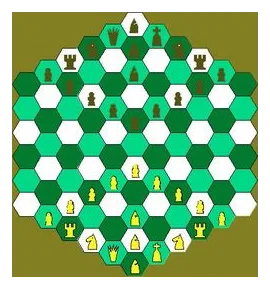
Hexagonal Chess box art

Hexagonal Chess

Players

2

Time

?-?

Age

10+

Weight

3.86

Rating

6.93

Fit

Teach 2.3

Teaching signal

Replay 4.0

High replayability

Interaction 3.8

Highly interactive

Scaling 4.0

Scales well

Strategy 4.7

Deep strategy

Control 4.3

More strategic control

Table feel

Hexagonal Chess has a high level of direct confrontation and strategic depth. Players need to constantly be aware of and react to each other's strategies and turns. However, there is minimal emphasis on cooperation as it is primarily a competitive game. Overall, the game has a strong interaction score.

Replay value

Hexagonal Chess has a high replayability score due to its variability in gameboard, expansions available, strategic depth, scalability, and player interaction. While it may take some time to learn, the depth it offers makes it worth the investment.

Luck profile

Hexagonal Chess has a low influence of luck. Random elements have minimal impact on the game outcome, and players have substantial ability to mitigate randomness through strategic decisions and planning. The game outcome is primarily determined by player strategy and decisions, with luck playing a minor role.

Overview

Over the years a number of chess variants have been proposed for boards featuring hexagonally shaped cells (commonly called hexes). The most popular of these is Hexagonal Chess which was invented in 1936 by Wladyslaw Glinski of Poland. David Pritchard says, in the Encyclopedia of Chess Variants, that Glinski's game is played by over half-a-million people, mostly in Eastern Europe.
Media

No media imported yet.

Editions

Edition Year Language Publisher / Region
No editions imported yet.

Files

No files imported yet.

Commerce

No commerce mappings imported yet.

Credits

Designers

1
W?adyslaw Gli?ski

Publishers

5
(Web published) The Game Crafter, LLC John Jaques of London Spó?dzielnia Pracy "Jedno??" Cieszyn WOSI "Wspólna Sprawa"

Linked items

No linked items imported yet.