Overview
At a glance
Is this game right for my group?
ABG editorial scores on a 1–5 scale.
Harder to teach
High replayability
Highly interactive
Scales well
Deep strategy
How it plays
How does it play?
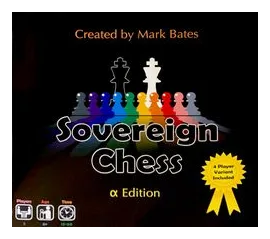
The theme of Sovereign Chess is chess on a larger board (16x16) with multiple colors of neutral pieces around the edge of the board. Each player begins with a normal complement of chess pieces--one player is black, and the other is white.
Core mechanisms
Key systems that shape the decisions players make.
Read the full game description
The theme of Sovereign Chess is chess on a larger board (16x16) with multiple colors of neutral pieces around the edge of the board. Each player begins with a normal complement of chess pieces--one player is black, and the other is white. Moves follow that of traditional chess, with a few variations--most notably that pawns may move orthogonally (and capture diagonally) toward the center of the board. When a player's piece is on a colored square, she controls the pieces of that color. Players can control multiple colors at once, either with a number of their own pieces, or through a "chain" of pieces. For example, if the white player has her pawn on a red square, and then moves a red pawn to the blue square, then she controls both red and blue. The goal of the game is to checkmate the opposing king.