Overview
At a glance
Is this game right for my group?
ABG editorial scores on a 1–5 scale.
Harder to teach
High replayability
Highly interactive
Scales well
Deep strategy
How it plays
How does it play?
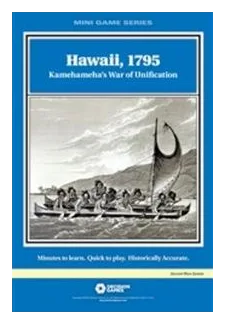
Skirmishes, raids, and abortive diplomacy had divided the Hawaiian Islands from one another. In 1795, Kamehameha unified the big island of Hawaii and set out to bring the other islands under one high king.
Core mechanisms
Key systems that shape the decisions players make.
Campaign Card Play
Play cards to command conflicts and carry consequences through a campaign.
Movement Points
Spend a movement allowance across spaces with different costs.
Dice Rolling
Roll dice to introduce uncertainty into actions, production, movement, or resolution.
Point-to-Point Movement
Move along explicit connections between named locations or nodes.
Simulation
Model a real or imagined system through detailed cause-and-effect rules.
Read the full game description
Skirmishes, raids, and abortive diplomacy had divided the Hawaiian Islands from one another. In 1795, Kamehameha unified the big island of Hawaii and set out to bring the other islands under one high king. This is a two-player game of Kamehameha’s campaign of unification. One player controls the forces of Kamehameha, the other commands the allied chiefs of Oahu and Maui. Movement carries armies along the Hawaiian chain, followed by tactical combat for control of each island. Counters represent warriors, musketeers, pikemen, elite guards, cannons, and canoes. The game mechanics are based on the Ancient Wars system. Cards generate special events, such as intervention by the forces of Kauai, the acquisition of cannons from European powers, or granting one player tactical advantages or additional forces. —description from the publisher