Overview
At a glance
Is this game right for my group?
ABG editorial scores on a 1–5 scale.
Harder to teach
High replayability
Highly interactive
Scales well
Deep strategy
How it plays
How does it play?
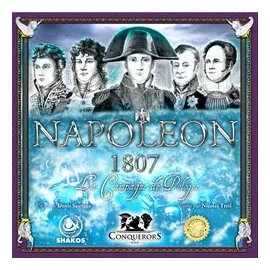
After the defeats of Auerstaedt and Jena, Prussia collapsed but has not yet surrendered. Their Russian ally arrives by the east to defy Napoléon.
Core mechanisms
Key systems that shape the decisions players make.
Campaign Card Play
Play cards to command conflicts and carry consequences through a campaign.
Dice Rolling
Roll dice to introduce uncertainty into actions, production, movement, or resolution.
Movement Points
Spend a movement allowance across spaces with different costs.
Events
Triggered events alter the shared state, rules, or available choices.
Point-to-Point Movement
Move along explicit connections between named locations or nodes.
Simulation
Model a real or imagined system through detailed cause-and-effect rules.
Read the full game description
After the defeats of Auerstaedt and Jena, Prussia collapsed but has not yet surrendered. Their Russian ally arrives by the east to defy Napoléon. The tough Polish campaign is beginning. When the game meets History Napoléon 1807 is a game at the crossroads of History and simulation. It uses the same game system as Napoléon 1806. With Napoléon 1807, in 1 to 2 hours, two players will relive the clashes between Russians and French in the heart of winter 1806-1807 in Poland. Three campaigns are proposed that retrace the terrible events that will culminate in the famous battles of Pultusk, Eylau and Friedland. Napoléon 1807 is intended for seasoned grognads as well as for young conscripts who want to try a new playfull sensation. Strategy, anticipation, decision, are the engines of the Napoléon 1807 game system.