Overview
At a glance
Is this game right for my group?
ABG editorial scores on a 1–5 scale.
Harder to teach
High replayability
Highly interactive
Scales well
Deep strategy
How it plays
How does it play?
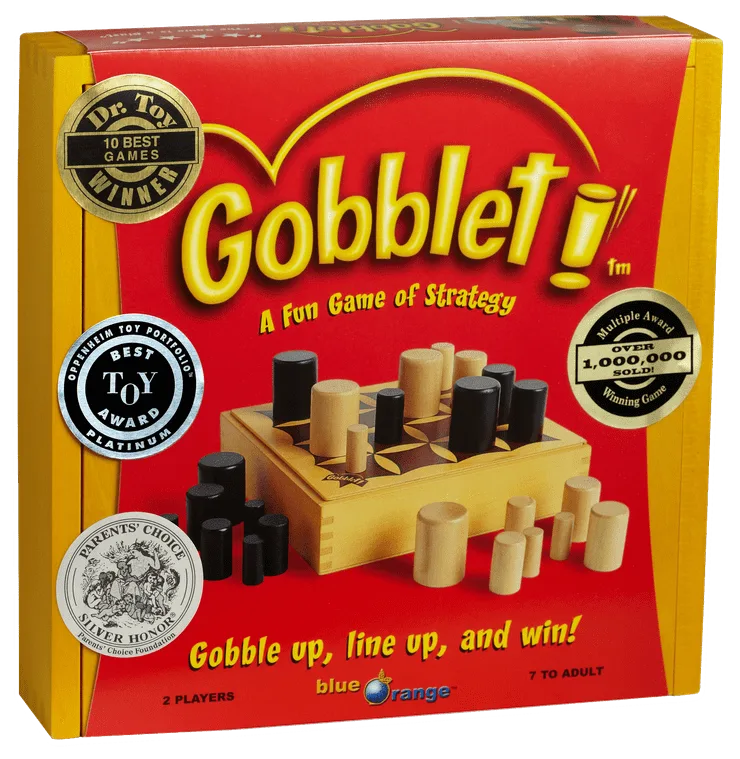
Gobblet is an abstract game played on a 4x4 grid with each of the two players having twelve pieces that can nest on top of one another to create three stacks of four pieces. Your goal in Gobblet is to place four of your pieces in a horizontal, vertical or diagonal row.
Core mechanisms
Key systems that shape the decisions players make.
Read the full game description
Gobblet is an abstract game played on a 4x4 grid with each of the two players having twelve pieces that can nest on top of one another to create three stacks of four pieces. Your goal in Gobblet is to place four of your pieces in a horizontal, vertical or diagonal row. Your pieces start nested off the board. On a turn, you either play one exposed piece from your three off-the-board piles or move one piece on the board to any other spot on the board where it fits. A larger piece can cover any smaller piece. A piece being played from off the board may not cover an opponent's piece unless it's in a row where your opponent has three of his color. Your memory is tested as you try to remember which color one of your larger pieces is covering before you move it. As soon as a player has four like-colored pieces in a row, he wins — except in one case: If you lift your piece and reveal an opponent's piece that finishes a four-in-a-row, you don't immediately lose; you can't return the piece to its starting location, but if you can place it over one of the opponent's three other pieces in that row, the game continues. _______________ Similiar to : Cover Up