Table feel
Go-Moku has a high level of direct confrontation and strategic depth. Players need to pay attention to each other's moves frequently. However, there is minimal emphasis on cooperation in the game.
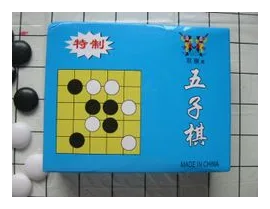
"Go-Moku" (Japanese - also spelled "Gomoku") or "wuziqi" (Chinese) is a very old game played with a Go set. The game can also be played on a sheet of graph paper using X's and O's. It is similar in idea to tic-tac-toe, but far greater in scale and complexity. The name means "five...
Players
2
Time
?-?
Age
8+
Weight
1.86
Rating
5.94
Should this hit the table?
Go-Moku has a high level of direct confrontation and strategic depth. Players need to pay attention to each other's moves frequently. However, there is minimal emphasis on cooperation in the game.
Teaching signal
High replayability
Highly interactive
Scales well
Deep strategy
More strategic control
Go-Moku has a high level of direct confrontation and strategic depth. Players need to pay attention to each other's moves frequently. However, there is minimal emphasis on cooperation in the game.
Go-Moku offers a high degree of variability with its gameboard, allowing for different experiences each time it is played. The presence of expansions adds some new content and gameplay elements, enhancing the replay value. The game also provides deep strategic possibilities and room for players to improve their tactics over time. The player interaction score is average, and the game scales well with different numbers of players. While it may take some time to learn, the depth it offers justifies the effort. Overall, Go-Moku has a solid replayability score of 7.8.
Go-Moku has a moderate influence of luck. While random elements have minimal impact on the game outcome, players have substantial ability to mitigate randomness through strategic decisions and planning. The game outcome is primarily determined by player strategy and decisions, with luck playing a minor role.
Overview
"Go-Moku" (Japanese - also spelled "Gomoku") or "wuziqi" (Chinese) is a very old game played with a Go set. The game can also be played on a sheet of graph paper using X's and O's. It is similar in idea to tic-tac-toe, but far greater in scale and complexity. The name means "five points." It is debated whether this game originated in China or Japan, with more evidence pointing to the former. The object is to get five stones in a row. The game is played on a 19x19 board (such as the board used in Go), creating a large and open field to complete this objective. The game can also be played on a smaller board, such as the popular 15x15 option. If played perfectly, Black (who goes first) can always win the game. Even before this was proven, the game was recognized to be easier for Black. This problem is solved in Renju. which is often seen as the adult contemporary to the kids' Go-Moku.
Media
Images, galleries, and videos are grouped here so the page feels visual before every asset is fully hosted.
Editions
| Edition | Year | Language | Publisher / Region |
|---|---|---|---|
| No editions imported yet. | |||
Files and documents
No files imported yet.
Commerce mapping
No commerce mappings imported yet.
Credits
Linked items
Related games and expansions help build a connected catalog around every title.
No linked items imported yet.