Overview
At a glance
Is this game right for my group?
ABG editorial scores on a 1–5 scale.
Harder to teach
High replayability
Highly interactive
Scales well
Deep strategy
How it plays
How does it play?
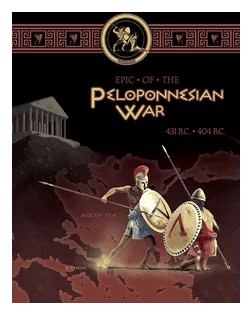
In the year 431BC, the Greek world was dominated by the Athenian Empire, due to their naval supremacy of the Aegean. Only the Spartans dared to challenge their might through the strength of their unsurpassed Hoplite troops.
Core mechanisms
Key systems that shape the decisions players make.
Read the full game description
In the year 431BC, the Greek world was dominated by the Athenian Empire, due to their naval supremacy of the Aegean. Only the Spartans dared to challenge their might through the strength of their unsurpassed Hoplite troops. The result was a 30-year conflict that ended in the destruction of Greek dominance in the ancient world. Two to four players use military force and political influence in their struggle to control the city-states of ancient Greece. Playing time ranges from 4-10 hours for short scenarios, to 20+ hours for the full campaign game, as players mobilize forces four times a year, and deploy them three times each season. As the leader of the Athenian Empire, can you save Athens' glory from the Spartan onslaught? As the leader of the Peloponnesian League, can you free Greece from Athenian tyranny without destroying it in the process? Players have a full range of strategic options, including sieges, constructing and destroying fortifications, razing enemy cities, foraging and raiding. Event Cards provide both random events (such as storms at sea, bad omens, the crippling plague at Athens, etc.) and strategic targets (city betrayals, rebellion of Athenian regions, Persian support, the Sicilian Expedition, among others). Fleet units represent 25 triremes, the light war galleys of the ancient Mediterranean, plus associated transport vessels. Hoplite units represent 1,000 heavily-armored Greek infantrymen. Each cavalry unit represents about 400 men and horses. Light infantry includes all types of lightly armored foot soldiers, including missile troops and barbarians, with each unit representing between 1,000 and 5,000 men. The rules allow for historically accurate periods of peace, where both sides caught their breath while preparing for a renewed struggle. The Epic of the Peloponnesian War is a complete simulation of this conflict. Scenarios include the introductory Argive League scenario, played on only a portion of the map; three scenarios each covering only a portion of the war; and the full Campaign Game for 2-4 players (adding Thebes and Corinth to the Peloponnesian side as the third and fourth players).