Overview
At a glance
Is this game right for my group?
ABG editorial scores on a 1–5 scale.
Harder to teach
High replayability
Highly interactive
Scales well
Deep strategy
How it plays
How does it play?
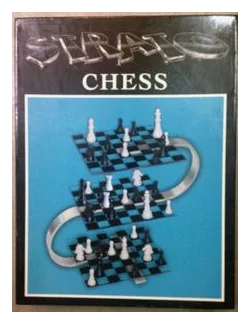
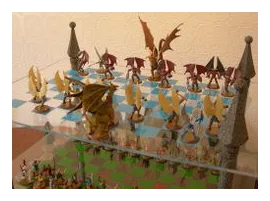
Dragon Chess first appeared in Dragon Magazine issue 100, and was also featured in the short story "At Moonset Blackcat Comes" in the same issue. It is a 3D Chess game that is played on three 8x12 boards stacked above each other.
Core mechanisms
Key systems that shape the decisions players make.
Read the full game description
Dragon Chess first appeared in Dragon Magazine issue 100, and was also featured in the short story "At Moonset Blackcat Comes" in the same issue. It is a 3D Chess game that is played on three 8x12 boards stacked above each other. The top board represents the air and features pieces like the Griffon and the Dragon. The middle board represents the land and has pieces like the Oliphant, the Thief, and (of course) the King. The bottom board represents the underworld and contains pieces like the Dwarf and the Elemental. Like regular chess, the object is to checkmate your opponent's King. Many pieces move like their chess counterparts, but many others have unconventional moves taken from other chess variants that are further complicated by the game's three dimensional nature. For example, on the upper board, a Sylph piece moves like a Berolina pawn. It may make a non-capturing move one space diagonally forward, or it may capture by moving directly forward one space. It may also capture by moving straight down to the middle board. While on the middle board, the Sylph cannot move at all except to make a non-capturing move back to the top board. It may move to the square directly above it OR any empty one of the six home squares that any friendly Sylph occupied at the start of the game.