Overview
At a glance
Is this game right for my group?
ABG editorial scores on a 1–5 scale.
Harder to teach
High replayability
Highly interactive
Scales well
Deep strategy
How it plays
How does it play?
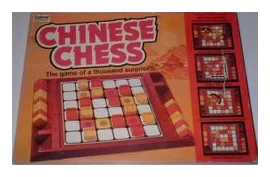
Despite its name, this game has nothing to do with Xiangqi, the *real* Chinese Chess. It does have original mechanics, though.
Core mechanisms
Key systems that shape the decisions players make.
Read the full game description
Despite its name, this game has nothing to do with Xiangqi, the *real* Chinese Chess. It does have original mechanics, though. BGG user chas59 states that the game was designed by Ron Dubrin of Mew York. The pieces start out filling the 6x6 board except for the central 2x2 area. Both players move both sets of pieces; the trick is that one player jumps same-coloured pieces whilst the other jumps different-coloured pieces. Jumped pieces are removed, and the object of the game is to capture 13 pieces. When you land on same/different-coloured square (there are 12 coloured squares, surrounding the central 2x2 area), you get to go again. Multiple jumps are possible. If you cannot jump, you slide, moving like a rook. Lastly, you cannot move a piece that's just been moved by the opponent.