Overview
At a glance
Is this game right for my group?
ABG editorial scores on a 1–5 scale.
Harder to teach
High replayability
Highly interactive
Scales well
Deep strategy
How it plays
How does it play?
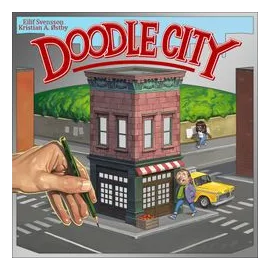
Doodle City is a quick family game of city building. By drawing a network of roads on their play sheet, players are building a city and trying to score points for their hotels, shops and taxis — all while avoiding pollution.
Core mechanisms
Key systems that shape the decisions players make.
Line Drawing
Draw lines to connect, divide, trace, or claim parts of the play area.
Paper-and-Pencil
Record choices and results directly on a personal sheet.
Dice Rolling
Roll dice to introduce uncertainty into actions, production, movement, or resolution.
Network and Route Building
Create connected routes that improve reach, delivery, control, or scoring.
Read the full game description
Doodle City is a quick family game of city building. By drawing a network of roads on their play sheet, players are building a city and trying to score points for their hotels, shops and taxis — all while avoiding pollution. Working out an ideal road network can be quite the puzzle, so before the game begins roads through parks are randomized, making sure that no two games will be alike. Each round, one white die per player, one additional white die, and a blue die are rolled onto the table. The blue die indicates which column the players must use, while each white die indicates a row. In turn each player picks a white die and draws in the given space. In most spaces you draw roads, but in parks you instead build houses. You can draw only once in each space, and if on your turn you cannot draw, you gain pollution. A building is scored the moment you draw in its space. For example, when you draw a road through a hotel space, you score points equal to the length of the road passing through that hotel. Shops score according to how many houses are currently connected to the shop. There are also bonuses awarded to the first player who connects a shop to a certain number of houses. The game ends when one player completes the highest possible hotel or shop score, or when a player loses his last tree due to pollution. Final scores are for connected taxis and for having least/most pollution.