Overview
At a glance
Is this game right for my group?
ABG editorial scores on a 1–5 scale.
Harder to teach
High replayability
Highly interactive
Scales well
Deep strategy
How it plays
How does it play?
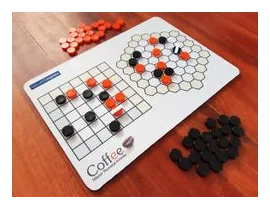
Coffee is a two-player abstract board game designed by Néstor Romeral Andrés. The goal of the game is to create a line of stones of your color, or to prevent your opponent from making a legal placement of the white rod.
Core mechanisms
Key systems that shape the decisions players make.
Read the full game description
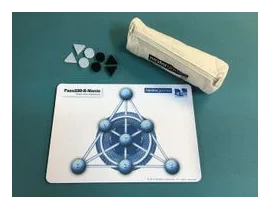
Coffee is a two-player abstract board game designed by Néstor Romeral Andrés. The goal of the game is to create a line of stones of your color, or to prevent your opponent from making a legal placement of the white rod. When placing the rod in a black or orange stone, it looks like a coffee seed. Hence the name Coffee. This is what you need in order to play Coffee: A hexagonal board with more than 3 cells per side or a square board with more than 4 cells per side (NESTORGAMES version has up to 5 cells per side for the hexagonal board and up to 7 cells per side for the square board). A supply of black and orange stones. A small white rod. Black starts by placing a stone in an empty cell, and then placing the white rod on it, pointing in any direction (3 directions for a hexhex board, or 4 for a square board). From now on, starting with Orange, players alternate turns first placing a stone in an empty cell in the direction indicated by the rod, and then placing the rod on it, pointing in any direction. It is illegal to place the rod so that the next player has no free spaces available. The game ends in one of the following cases: One player wins the game by making a line of ‘n’ stones of his color (with ‘n’ being the victory condition). One player loses the game because he cannot place the rod in a legal position. If both cases happen on the same turn, the first case prevails. Notice that ties are not possible. The set includes one extra white rod so that 2 couples can play at the same time on the smallest boards.