Overview
At a glance
Is this game right for my group?
ABG editorial scores on a 1–5 scale.
Harder to teach
High replayability
Highly interactive
Scales well
Deep strategy
How it plays
How does it play?
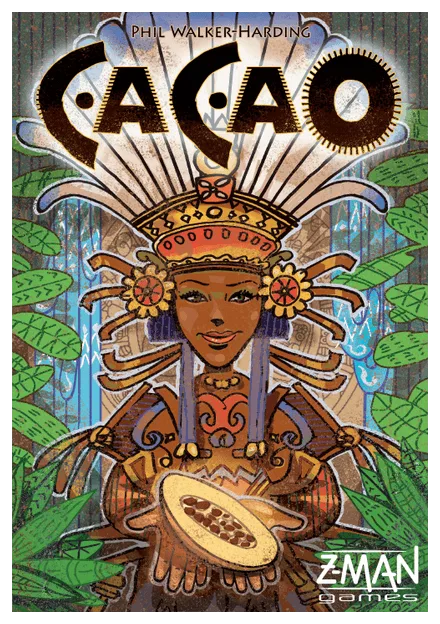
Cacao is a tile-placement game that immerses players in the exotic world of the "fruit of the Gods".
Core mechanisms
Key systems that shape the decisions players make.
Area Majority
Compete to have the strongest presence in areas that award control or points.
Map Addition
Expand the playable map by adding new tiles, regions, or spaces.
Hand Management
Time and sequence a limited hand of cards to preserve future options.
Tile Placement
Place tiles to build a shared or personal spatial arrangement.
Read the full game description
Cacao is a tile-placement game that immerses players in the exotic world of the "fruit of the Gods". As the chief of your tribe, you must lead your people to prosperity through the cultivation and trade of cacao — and to do that, you'll need to put them to work in the best way possible. In the game, each player has an individual deck of square worker tiles, with the number of workers on each side of the tile varying from tile to tile. The playing area starts with only a couple of jungle tiles in play: a cacao field and a small market; two jungle tiles are laid face up, and the remaining jungle tiles stacked as a draw pile. On a player's turn, he places one of her worker tiles on the board adjacent to one or more jungle tiles already in play, then (if two worker tiles are next to an empty space) adds one of the jungle tiles to the playing area in this space. Her workers then get busy and deliver the results of their effort: If you placed workers next to a cacao field, you receive one or two cacao markers per worker; if they're next to a market, you can choose to sell one cacao marker per worker at the listed price; if next to a well, you receive water; if next to a temple, they stand and look good until the end of the game; and so on. He then refills her hand from her personal deck to three worker tiles. Once all players have used all of their worker tiles, the game ends. Players score (or lose) points based on their water supply, and each temple rewards whichever players sent the most workers to it. In the end, whoever has collected the most gold wins.