Overview
At a glance
Is this game right for my group?
ABG editorial scores on a 1–5 scale.
Harder to teach
High replayability
Highly interactive
Scales well
Deep strategy
How it plays
How does it play?
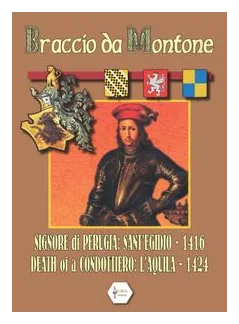
Braccio da Montone was a notorious and respected Condottiero of the first half of XVth century. This is the third game in the series that began with Guelphs and Ghibellines.
Core mechanisms
Key systems that shape the decisions players make.
Grid Movement
Move pieces between adjacent spaces on a regular grid.
Dice Rolling
Roll dice to introduce uncertainty into actions, production, movement, or resolution.
Movement Points
Spend a movement allowance across spaces with different costs.
Hexagon Grid
Use a hexagonal map where each space connects evenly in six directions.
Line of Sight
Visibility between pieces determines valid targets, movement, or effects.
Read the full game description
Braccio da Montone was a notorious and respected Condottiero of the first half of XVth century. This is the third game in the series that began with Guelphs and Ghibellines. In Braccio da Montone there are no turns but a continuous series of Condottiero (Leader) activations. A Condottiero's "Command Capacity" is the number of order points that a Condottiero receives when he is activated. He uses these order points to move, fire and attack with his in-command units of his own “Battaglia” and it emphasizes the fatigue of the armies during the course of the battle. This system is integrated with ad hoc rules needed to reflect the different tactics invented and used by Braccio da Montone (the so-called Scuola Braccesca. The Victory Level mechanic gives uncertainty as to how much further the game has to go. The game simulates the two major battles fought by the condottiero: Sant'Egidio (July 12, 1416), whereby he became Lord of Perugia and l'Aquila (June 2, 1424), in which he was defeated and mortally wounded. Components: Two maps 84x60 cm; 176 5/8” and 140 1/2” die-cut counters; Three Player Aid Carts; A rule booklet with scenarios and an historical background. Scale: 1 hex: 100 meters (about 110 yards) 1 strengh point: 100-200 men for the cavalry, 250-500 men for infantry, 750-1,000 men for the militia