Overview
At a glance
Is this game right for my group?
ABG editorial scores on a 1–5 scale.
Harder to teach
High replayability
Highly interactive
Scales well
Deep strategy
How it plays
How does it play?
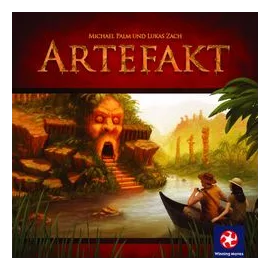
During an excavation archaeologists found hints that point to a legendary treasure containing valuable artifacts such as royal jewels, holy relics and magnificent weapons.
Core mechanisms
Key systems that shape the decisions players make.
Read the full game description
During an excavation archaeologists found hints that point to a legendary treasure containing valuable artifacts such as royal jewels, holy relics and magnificent weapons. These artifacts were alledgedly hidden by a secret order in various mythical places, and hardly has the first information about this treasure been leaked before archaeologists and adventurers race off to try to discover this artifact before anyone else can. In Artefakt, each player starts with three experts (game pieces) to send on a treasure hunt, using dice and cards to try to get them to the most rewarding locations in order to find fragments of artifacts. Each round, after rolling the dice and laying out new fragments to discover, players secretly assign one of their four movement cards (numbered 1-4) to each of their three experts. In turn order, players reveal the first card, move that figure clockwise or counterclockwise that number of spaces around the circle of ten tiles, then reveal the second card, and so on. Once all experts have moved, the tiles are resolved in numerical order. Any player who stands on a tile with no competition takes all the fragments located there; if more than one player is on a tile, the player with the most experts either takes all the fragments on that tile or one face-down fragment from another player on that tile. After a player takes or steals fragments, he can choose to use the special power on that tile: break a tie in your favor on another tile, take a fragment from the pool, move one expert owned by another player one space, and so on. In the basic game, only four of the tiles are face-up with active powers; in the advanced game, these same four tiles start face-up but at the end of a round the starting player turns one tile of his choice face-up before passing the starting player marker. As soon as one player collects all four different fragments of one artifact, he wins the game.