Overview
At a glance
Is this game right for my group?
ABG editorial scores on a 1–5 scale.
Harder to teach
High replayability
Low interaction
Scales well
Deep strategy
How it plays
How does it play?
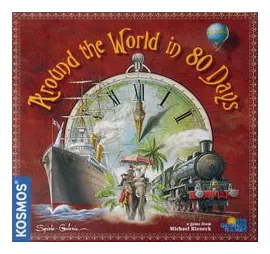
Inspired by the Jules Verne novel, players are following in Phileas Fogg and Passepartout's footsteps, attempting to travel around the world in 80 days on a map with Victorian-era decorations. On a player's turn, he chooses one of the face-up travel cards.
Core mechanisms
Key systems that shape the decisions players make.
Open Drafting
Select cards or items from a shared face-up display.
Hand Management
Time and sequence a limited hand of cards to preserve future options.
Point-to-Point Movement
Move along explicit connections between named locations or nodes.
Race
Compete to reach a destination, threshold, or objective before opponents.
Read the full game description
Inspired by the Jules Verne novel, players are following in Phileas Fogg and Passepartout's footsteps, attempting to travel around the world in 80 days on a map with Victorian-era decorations. On a player's turn, he chooses one of the face-up travel cards. Each card comes with an extra (getting to be first player in the next round, for example). Then he decides whether to travel to the next city. Does he want to wait until the next round in hopes of better cards, or will he make his journey now? If so, he must have and play the required travel cards. The two transportation types are trains and ships. For example, 2 ship cards are required to travel from Suez to Bombay, so 2 ship cards must be played; train cards won't help in this instance. Time is spent each step of the way in the form of days, and (while meeting certain other requirements) the winner is the player who spends the fewest number of days getting around the world. The number of days depends on the travel cards used, plus help from special cards, hindrance from the meandering detective, and so on.