Overview
At a glance
Is this game right for my group?
ABG editorial scores on a 1–5 scale.
Harder to teach
High replayability
Highly interactive
Scales well
Deep strategy
How it plays
How does it play?
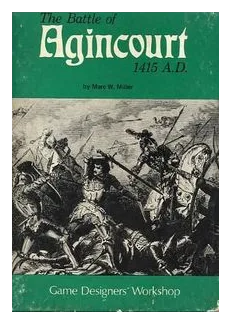
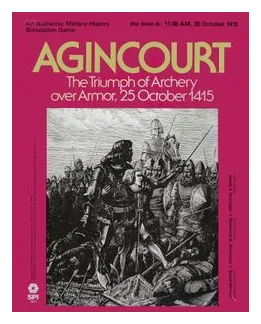
Agincourt recreates the well known battle in 1415 of the same name. Each hex is 34 yards, counters from 250-500 men (1000 if double sized) or 1-2 artillery pieces.
Core mechanisms
Key systems that shape the decisions players make.
Grid Movement
Move pieces between adjacent spaces on a regular grid.
Dice Rolling
Roll dice to introduce uncertainty into actions, production, movement, or resolution.
Movement Points
Spend a movement allowance across spaces with different costs.
Hexagon Grid
Use a hexagonal map where each space connects evenly in six directions.
Combat Results Table
Compare opposing strength as a ratio, then consult a table to resolve combat.
Simulation
Model a real or imagined system through detailed cause-and-effect rules.
Read the full game description
Agincourt recreates the well known battle in 1415 of the same name. Each hex is 34 yards, counters from 250-500 men (1000 if double sized) or 1-2 artillery pieces. Each turn is 3 minutes. Each player alternates as the "phasing" player and moves in impulses, after each of which the opposing player can engage in archery fire. After movement morale is checked and then melee combat may occur. Combat results are calculated by percentile dice on a CRT. Losses are imposed by "line" of which units start with 2, 3, or 7. When a unit loses all its lines it is eliminated. Morale is tracked both for individual units and for each side as a whole.