Overview
At a glance
Is this game right for my group?
ABG editorial scores on a 1–5 scale.
Harder to teach
High replayability
Highly interactive
Scales well
Deep strategy
How it plays
How does it play?
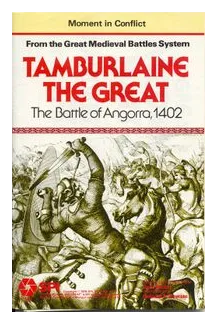
Tamburlaine the Great is a Tactical level simulation of the Battle of Angora on 21 June 1402, which was the climax of the Tartar invasion of Asia Minor.
Core mechanisms
Key systems that shape the decisions players make.
Grid Movement
Move pieces between adjacent spaces on a regular grid.
Dice Rolling
Roll dice to introduce uncertainty into actions, production, movement, or resolution.
Movement Points
Spend a movement allowance across spaces with different costs.
Hexagon Grid
Use a hexagonal map where each space connects evenly in six directions.
Combat Results Table
Compare opposing strength as a ratio, then consult a table to resolve combat.
Simulation
Model a real or imagined system through detailed cause-and-effect rules.
Read the full game description
Tamburlaine the Great is a Tactical level simulation of the Battle of Angora on 21 June 1402, which was the climax of the Tartar invasion of Asia Minor. Sultan Bayazid I and his Ottoman Turks, fresh from their victory against the Christians at the Battle of Nicopolis, met Tamburlaine's Tartar and Mongol hordes northeast of modern day Ankara. Unit types included in the game are: infantry, short bow archers, crossbowmen, cavalry, elephants, and wagons. The map scale is 50 yards from hex side to hex side, and each game-turn represents 20 minutes. In addition to being published as a separate game, Tamburlaine the Great was also published as part of SPI's Great Medieval Battles Quadrigame.