Overview
At a glance
Is this game right for my group?
ABG editorial scores on a 1–5 scale.
Harder to teach
High replayability
Highly interactive
Scales well
Deep strategy
How it plays
How does it play?
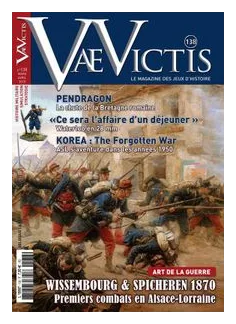
Wissembourg et Spicheren 1870: Premiers combats en Alsace-Lorraine (First battles in Alsace-Lorraine) is a wargame published in "Vae Victis" issue #138 which simulate two battles from the beginning of the 1870 French-Prussian War: the Battle of Wissembourg (or Battle of Weissenburg), on 4 August 1870, was the first of the Franco-Prussian War and the first French defeat of 1870. It opposed three German army corps (one Bavarian and two Prussian) and the small French garrison under General Douay at Wissembourg.
Core mechanisms
Key systems that shape the decisions players make.
Grid Movement
Move pieces between adjacent spaces on a regular grid.
Dice Rolling
Roll dice to introduce uncertainty into actions, production, movement, or resolution.
Hexagon Grid
Use a hexagonal map where each space connects evenly in six directions.
Simulation
Model a real or imagined system through detailed cause-and-effect rules.
Read the full game description
Wissembourg et Spicheren 1870: Premiers combats en Alsace-Lorraine (First battles in Alsace-Lorraine) is a wargame published in "Vae Victis" issue #138 which simulate two battles from the beginning of the 1870 French-Prussian War: the Battle of Wissembourg (or Battle of Weissenburg), on 4 August 1870, was the first of the Franco-Prussian War and the first French defeat of 1870. It opposed three German army corps (one Bavarian and two Prussian) and the small French garrison under General Douay at Wissembourg. Douay's division held the town and the heights of Geisberg until early afternoon before yielding to the mass. the Battle of Spicheren (also known as the Battle of Forbach), on 5 August 1870, was the second of three critical French defeats. The third was The Battle of Wörth (also known as Fröschwiller or Reichshoffen). The French II Corps under General Frossard had a good position, a fortified line between Spicheren and Forbach, and tried to block the Prussian troops under General Karl Friedrich von Steinmetz. Their retreat was ill-prepared and caused the rest of the Lorraine army to retreat to the walls of Metz. (sources : rulebook and description from the Publisher)