Overview
At a glance
Is this game right for my group?
ABG editorial scores on a 1–5 scale.
Highly interactive
How it plays
How does it play?
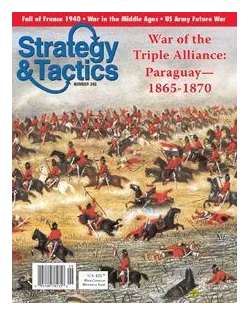
The Triple Alliance War (TAW) is a two-player, low-to-intermediate complexity, strategic-level simulation of the second-largest war ever fought in the New World (the largest having been the American Civil War).
Core mechanisms
Key systems that shape the decisions players make.
Read the full game description
The Triple Alliance War (TAW) is a two-player, low-to-intermediate complexity, strategic-level simulation of the second-largest war ever fought in the New World (the largest having been the American Civil War). The Paraguayan player is attempting to hold off the onslaught of three allied nations: Argentina, Brazil and Uruguay. The Allied player is generally on the offensive, attempting to win the game by invading Paraguay and seizing key areas on map within that country. The Paraguayan player is primarily on the defensive, but the situation also allows for his prosecution of offensives, particularly in the early stage of the war. Game play encompasses the period that began historically in 1865 with the Paraguayans launching a preemptive strike into Argentine territory. The game ends during the first half of 1868 when, historically, the Allies broke through the Paraguayan river forts and went on to seize their capital. That advance signaled the ultimate doom of the Paraguayan cause and, though the war officially went on for another year and a half, that portion of it was more a rebellion-and-occupation struggle than an actual war. Each hexagon on the map represents approximately 15.5 miles (25 km) from side to opposite side. The ground units of maneuver for both sides are primarily battalions, along with some nominal "brigades" and "divisions," which are actually all really battalion-equivalents themselves. Each riverine unit represents on naval combat vessel or several armed rafts or transport ships. Game Turn 1 represents three months, while each one after that represents half a year.