Overview
At a glance
Is this game right for my group?
ABG editorial scores on a 1–5 scale.
Harder to teach
High replayability
Highly interactive
Scales well
Deep strategy
How it plays
How does it play?
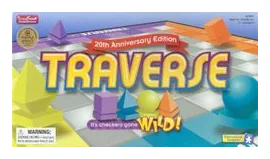
Traverse is played on a square "checker" game board with a 12 1/2" x 12 1/2" grid. Each player chooses one color of playing pieces.
Core mechanisms
Key systems that shape the decisions players make.
Read the full game description
Traverse is played on a square "checker" game board with a 12 1/2" x 12 1/2" grid. Each player chooses one color of playing pieces. Each player has eight pieces of the same color: 2 squares, 2 diamonds, 2 triangles, and 2 circles. Each player arranges their pieces in ANY ORDER within their starting row. The object of the game is to get ALL of your pieces into the starting row of the player sitting opposite of you. The pieces move in different directions depending upon the shape: Squares can move horizontally and vertically. Diamonds can move only diagonally. Triangles can move forward on the diagonals or straight backwards. Circles can move in any direction. Players take turns moving one piece each turn. Two pieces can not occupy the same space. Pieces can move in single space moves, one space at a time and only into an empty adjacent space as dictated by the piece's legal moves. Players can jump over their own or another player's piece. Jumped pieces are NOT captured, akin to Chinese Checkers. Players can string together a series of jumps if each individual jump in the series conforms to the rules governing single jumps. The first player to move all of their pieces into the destination row is the winner. Players can not force a draw. Listed on "GAMES 100" GAMES Magazine 1992 Mensa Select 2-4 players ages 7 to adult