Table feel
Quixo has a high level of direct confrontation and strategic depth, with frequent interaction between players. However, it does not require much cooperation.
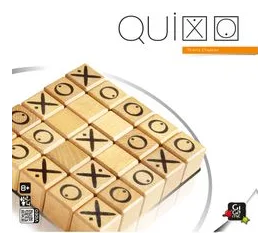
Quixo bears a superficial resemblance to Tic-Tac-Toe – with one player being crosses and the other circles, and with both trying to create a line of their symbol – but that's where the resemblance ends. The pieces in the game are cubes that have a circle on one side, a cross on a...
Players
2-4
Time
?-?
Age
8+
Weight
1.61
Rating
6.24
Should this hit the table?
Quixo has a high level of direct confrontation and strategic depth, with frequent interaction between players. However, it does not require much cooperation.
Teaching signal
High replayability
Highly interactive
Scales well
Deep strategy
More strategic control
Quixo has a high level of direct confrontation and strategic depth, with frequent interaction between players. However, it does not require much cooperation.
Quixo offers a high degree of variability with its gameboard, allowing for different experiences each time it is played. The presence of expansions adds some new content and gameplay elements, although not as impactful as desired. The game provides deep strategic possibilities and room for players to improve their tactics and strategies over time. The player interaction score is average. Quixo scales well with different numbers of players, maintaining its appeal and balance. The game is moderately easy to learn, striking a balance between depth and accessibility. Overall, Quixo has a good replayability score of 7.77 out of 10.
Quixo has a moderate influence of luck. Random elements have a notable but not exclusive impact on the game outcome. While players have substantial ability to mitigate randomness through strategic decisions and planning, luck still plays a significant role. The game outcome is primarily determined by player strategy and decisions, with luck playing a minor role.
Overview
Quixo bears a superficial resemblance to Tic-Tac-Toe – with one player being crosses and the other circles, and with both trying to create a line of their symbol – but that's where the resemblance ends. The pieces in the game are cubes that have a circle on one side, a cross on another, and blank faces on the other four; to set up the game, players place the 25 cubes with blanks face-up on the 5x5 grid in the game board. On a turn, the active player takes a cube that is blank or bearing his symbol from the outer ring of the grid, rotates it so that it shows his symbol (if needed), then adds it to the grid by pushing it into one of the rows from which it was removed. Thus, a few pieces of the grid change places each turn, and the cubes slowly go from blank to crosses and circles. Play continues until someone forms an orthogonal or diagonal line of five cubes bearing his symbol, with this person winning the game.
Media
Images, galleries, and videos are grouped here so the page feels visual before every asset is fully hosted.
Editions
| Edition | Year | Language | Publisher / Region |
|---|---|---|---|
| No editions imported yet. | |||
Files and documents
No files imported yet.
Commerce mapping
Credits
Linked items
Related games and expansions help build a connected catalog around every title.
No linked items imported yet.