Overview
At a glance
Is this game right for my group?
ABG editorial scores on a 1–5 scale.
Harder to teach
High replayability
Highly interactive
Scales well
Deep strategy
How it plays
How does it play?
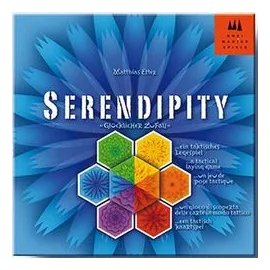
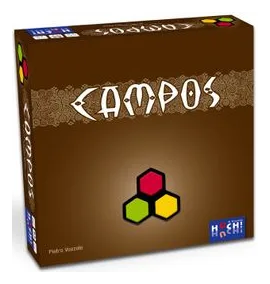
Pietro Vozzolo's Campos may look rather ingenious on first glance, but the game actually has little in common with that well-known Reiner Knizia design other than brightly-colored hexagons on plastic tiles.
Core mechanisms
Key systems that shape the decisions players make.
Read the full game description
Pietro Vozzolo's Campos may look rather ingenious on first glance, but the game actually has little in common with that well-known Reiner Knizia design other than brightly-colored hexagons on plastic tiles. Each player starts the game with 3-5 hidden scoring cards and two face-up triangular tiles, while one tiles is laid out in the center of the table. On a turn, a player can either add her two tiles to the growing hexagonal mess or add one tile to the central display, then play a scoring card. Each scoring card is read as follows: "If the largest contiguous mass of color A is larger than the largest contiguous mass of color B, then score points equal to the number of hexes in the largest contiguous mass of color C." Lots of contiguity in there! A player draws one or two new tiles at the end of her turn, and the game continues until either someone runs out of scoring cards or a player can't refill her visible display of tiles. In either case, each player again receives 3-5 scoring cards adding those to any remaining in hand then players start taking turns removing one or two tiles each turn, playing a scoring card if the player removes only one tile. The game ends once all the tiles have been removed from play, and the player with the highest score wins the game.