Overview
At a glance
Is this game right for my group?
ABG editorial scores on a 1–5 scale.
Harder to teach
High replayability
Highly interactive
Scales well
Deep strategy
How it plays
How does it play?
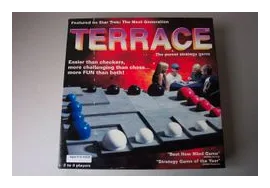
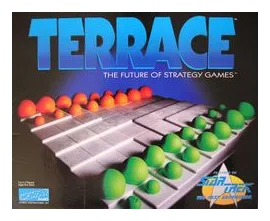
Terrace is a strategy game that is played on a three dimensional board with 64 squares of one color, which are arranged in L-shaped levels ("terraces") that rise stepwise from the board's lowest points in two diagonally opposite corners to its highest points in the two other corners. All pieces are shaped alike and move alike, but they are of 4 different sizes, and the smallest piece has the letter T carved into it.
Core mechanisms
Key systems that shape the decisions players make.
Read the full game description
Terrace is a strategy game that is played on a three dimensional board with 64 squares of one color, which are arranged in L-shaped levels ("terraces") that rise stepwise from the board's lowest points in two diagonally opposite corners to its highest points in the two other corners. All pieces are shaped alike and move alike, but they are of 4 different sizes, and the smallest piece has the letter T carved into it. The object is to win either by moving your T from its starting point at one corner to an opposite corner, or by capturing your opponent's T.