Overview
At a glance
Is this game right for my group?
ABG editorial scores on a 1–5 scale.
Harder to teach
High replayability
Highly interactive
Scales well
Deep strategy
How it plays
How does it play?
Published in GAMES Magazine, January/February 1981 issue, page 22 (with original rules on page 68) as "a gambling game 1,500 years ahead of its time." R. Wayne Schmittberger adapted the rules for streamlined play.
Core mechanisms
Key systems that shape the decisions players make.
Read the full game description
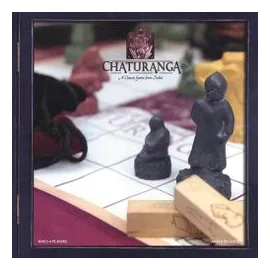
Published in GAMES Magazine, January/February 1981 issue, page 22 (with original rules on page 68) as "a gambling game 1,500 years ahead of its time." R. Wayne Schmittberger adapted the rules for streamlined play. From GAMES Magazine: "The oldest known form of chess, Chaturanga is a lively game in which moves are determined, as in backgammon, by a combination of dice rolls and player judgment." Online Play Ludoteka (real-time) The above article is incorrect, properly speaking. The game depicted with dice is "Chaturaji," a gambling game often using dice. "Chaturanga" is the earliest known form of Chess, originating in India, and bares only superficial resemblance to Chaturaji, in that both games use a selection of similar pieces. Chaturanga is played on an 8X8 grid with two players, and differs from modern Chess in some fairly significant ways: there is no castling, there are no En Passant captures, and pawns do not gain an initial two space move; the Elephant or "Gaji" (which inspired the Bishop) jumps only two spaces diagonally; the Queen equivalent, the Mantri, or "Advisor/Minister" moves only one space diagonally in any direction, and games can be won by Bare King and -lost- by Stalemating an opponent (which is precisely the opposite of the Persian descendant of Chaturanga, Shatranj.) Some moves and pieces are debated, as this is a very ancient game, and of course it evolved over time, but further research rewards a great deal of interesting discussion on the subject.